Static Fields: Fall-2025
HW 10 Practice (SOLUTION): Due W5 D5
- Energy of Four Charges
S1 5308S
Three charges are situated at the corners of a square (side \(s\)). Two have charge \(-q\) and are located on opposite corners. The third has charge \(+q\) and is opposite an empty corner.
-
How much work does it take to bring in another charge, \(+q\), from
far away and place it at the fourth corner?
To find the work needed, I need to calculate the potential at the final location of the fourth charge due to the presence of the other charges. (The subscripts denote the charge that is creating the potential.) \begin{align} W &= q\,V(\vec{r})\\ &= q \left( V_1+V_2+V_3 \right)\\ &= q \left( \frac{k(-q)}{s}+\frac{k(q)}{\sqrt{2}s}+\frac{k(-q)}{s}\right)\\ &= \frac{-k\,q^2}{s}\left(2-\frac{\sqrt{2}}{2}\right) \end{align}
Sense-making: The negative sign indicates that the charge is losing energy is being placed at the corner of the square.
-
How much work does it take to assemble the whole configuration of
four charges?
\begin{equation} W=\frac{1}{2}\sum_{i=1}^4 q_{i}V(\vec{r}_i) \end{equation} The potential for charges on opposite corners is the same (here, the subscripts denote the total potential at the location of the charge due to the presence of the other four charges): \begin{align} V_{T1} = V_{T3} &= \frac{k\,q^2}{s}\left(2-\frac{\sqrt{2}}{ 2}\right) \\ V_{T2} = V_{T4} &= \frac{-k\,q^2}{ s}\left(2-\frac{\sqrt{2}}{2}\right) \end{align}
\begin{align} W &= \frac{1}{2}\left[2(-q)V_1+2(q)V_2 \right]\\ &= \frac{(-q)\,k\,q^2}{s}\left(2-\frac{\sqrt{2}}{ 2}\right)+\frac{-(q)\,k\,q^2}{s}\left(2-\frac{\sqrt{2} }{2}\right)\\ &= -2\,\frac{k\,q^2}{s}\left(2-\frac{\sqrt{2}}{2}\right) \end{align}
Sense-making: The negative sign is still here, so the system loses some energy in order to be placed in the square. That checks out physically---if nothing is holding the charges in place, then they will tend to move toward each other, reducing the distance between them and further lowering the stored potential energy.
-
How much work does it take to bring in another charge, \(+q\), from
far away and place it at the fourth corner?
- Magnetic Field and Current, Version II
S1 5308S
Find the volume current density that produces the following magnetic field (expressed in cylindrical coordinates): \begin{equation} \vec{B}(\vec{r}) = \begin{cases} \dfrac{\mu_0\,I\,s}{2\pi a^2}\hat{\phi}& s\leq a \\\\ \dfrac{\mu_0\,I}{2\pi s}\hat{\phi}& a<s<b \\\\ 0& s>b \end{cases} \end{equation} What is a physical situation that corresponds to this current density?
Ampere's Law in differential form states that the curl of the magnetic field is the current density multiplied by \(\mu_0\). The magnetic field given only has a \(\hat{\phi}\) component and only depends on \(s\). Therefore, the only non-zero term in the curl (in cylindrical coordinates) is: \begin{equation} \vec{J}=\frac{1}{\mu_0}\vec\nabla \times \vec{B} =\frac{1}{\mu_0}\frac{1}{s}\frac{\partial}{\partial s}(s B_\phi)\hat{z} \end{equation}
Notice that you have to multiply the \(\phi\)-component of the vector field by \(s\) before differentiating. \begin{equation} \vec{J}(\vec{r}) = \begin{cases} \dfrac{I}{\pi a^2} \hat{z} & s \leq a \\ 0 & a < s < b \\ 0 & s > b \end{cases} \end{equation} How can it be that the magnetic field for \(s > b\) is zero? Well, Ampere's Law in integral form says that if I create an Amperian loop with \(s >b\), then the total current enclosed must be zero. But we know that there is non-zero current density in the \(s<a\) region, so there must be another charge density somewhere that makes the total enclosed current to be zero. The only place that could be is at \(s=b\). Therefore, there must be a surface current density at \(s=b\) with a total current \(I\), making the current density \begin{equation} \vec{K} = -\frac{I}{2 \pi b} \hat{z}, \end{equation} and the volume current density \begin{equation} \vec{J} = -\frac{I}{2 \pi b} \delta(s-b) \hat{z} \end{equation} at \(s=b\). Therefore, we have found \begin{equation} \vec{J}(\vec{r}) = \begin{cases} \dfrac{I}{\pi a^2} \hat{z} & s \leq a \\ 0 & a < s < b \\ -\dfrac{I}{2 \pi b} \delta(s-b) \hat{z} & s=b \\ 0 & s>b \end{cases} \end{equation} A physical situation that matches this is a thick wire with constant volume current density and radius \(a\) and a thin cylindrical shell with radius \(b\) and constant surface current density running in the opposite direction.
- Curl
S1 5308S
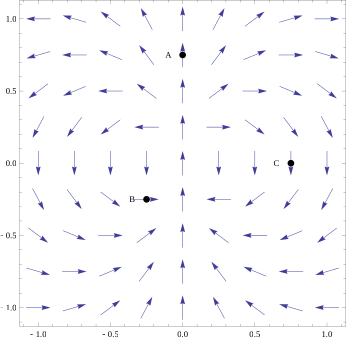
Shown above is a two-dimensional cross-section of a vector field. All the parallel cross-sections of this field look exactly the same. Determine the direction of the curl at points A, B, and C.
The curl can be determined as circulation per unit area. We will consider a counterclockwise loop centered on each point.
For point A, the field is symmetric about any loop we might choose. Any positive contribution along the left side is cancelled by a negative contribution along the right side. The top and bottom sides may be split into left and right halves that cancel.
For point B, the field has a component that is counterclockwise about the point (or zero), so that adds up to a curl in the positive \(z\)-direction.
For point C, the upper, lower, and right sides have a component that is clockwise about the point. The left side component of the field is counterclockwise, but is smaller than the right side due to the angle that the field makes to the path. The net circulation is therefore negative and the curl points in the negative \(z\)-direction.
As a side note, this vector field is \(\vec{F}(x, y) = \frac{2xy\hat{x} + (y^2 - x^2)\hat{y}}{x^2+y^2}\), which has a nontrivial divergence and curl.
- Symmetry Arguments for Amp\`ere's Law S1 5308S Use good symmetry arguments to find the possible direction for the magnetic field due to a current carrying wire. Also, use good symmetry arguments to find the possible functional dependence of the magnetic field due to a current carrying wire. Rather than writing this up to turn in, you should find a member of the teaching team and make the arguments to them verbally.