Static Fields: Fall-2025
HW 09 Practice (SOLUTION): Due W5 D3
- Divergence Estimate
S1 5306S
Suppose \(\boldsymbol{\vec\nabla}\cdot\boldsymbol{\vec F} = xyz^2\).
-
Find \(\boldsymbol{\vec\nabla}\cdot\boldsymbol{\vec F}\) at the point \((1,2,1)\).
Note: You are given \(\boldsymbol{\vec\nabla}\cdot\boldsymbol{\vec F}\), not \(\boldsymbol{\vec F}\)! - Using your answer to part (a), but no other information about the vector field \(\boldsymbol{\vec F}\), estimate the flux out of a small box of side \(0.2\) centered at the point \((1,2,1)\) and with edges parallel to the axes.
- Without computing the vector field \(\boldsymbol{\vec F}\), calculate the exact flux out of the box.
-
Find \(\boldsymbol{\vec\nabla}\cdot\boldsymbol{\vec F}\) at the point \((1,2,1)\).
- Divergence
S1 5306S
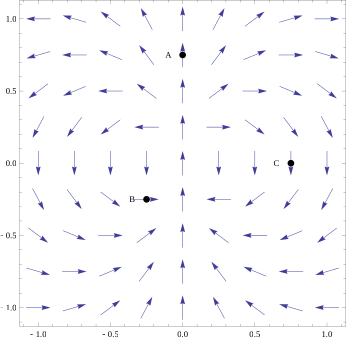
Shown above is a two-dimensional vector field.
Determine whether the divergence at point A and at point C is positive, negative, or zero.
To determine the sign of the divergence at each point, consider an infinitessimal box centered about that point. Then, estimate the flux through each side.
For point A, the top and bottom surfaces have very similar flux of opposite signs. The right and left sides, however, both have outward flux, so the net flux, and thus the divergence, is positive.
For point C, the top and bottom surfaces have symmetric vertical components of the field. On the left and right sides, the inward and outer components of the field cancel on the top and bottom of each side, giving a divergence of zero.