Central Forces: Spring-2026 HW 05 Practice (SOLUTION): Due W3 D3
Yukawa
S1 5537S
In a solid, a free electron doesn't see” a bare nuclear charge
since the nucleus is surrounded by a cloud of other electrons. The
nucleus will look like the Coulomb potential close-up, but be
screened” from far away. A common model for such problems is
described by the Yukawa or screened potential:
\begin{equation}
U(r)= -\frac{k}{r} e^{-\frac{r}{\alpha}}
\end{equation}
Graph the potential, with and without the exponential term.
Describe how the Yukawa potential approximates the “real”
situation. In particular, describe the role of the parameter
\(\alpha\).
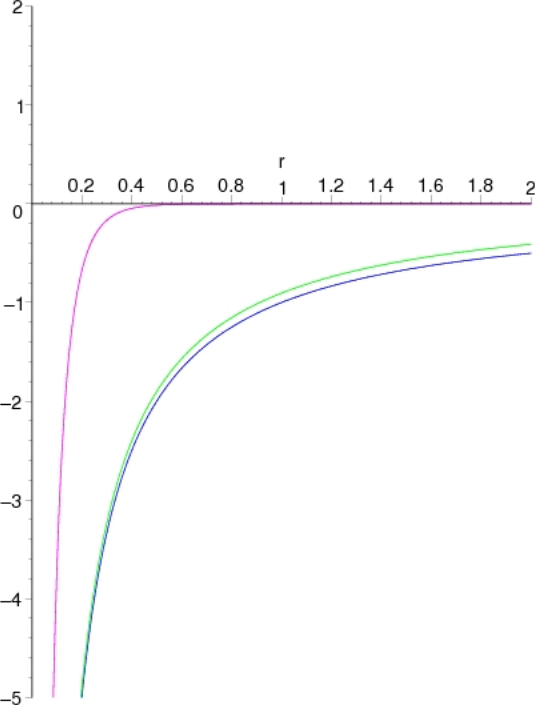
Several Yukawa potentials are plotted. Blue corresponds to
the ordinary Coulomb potential, green corresponds to
\(\alpha={10}\), and magenta corresponds to
\(\alpha=\frac{1}{10}\)
Notice that decreasing \(\alpha\) makes the potential fall to zero
faster.
Draw the effective potential for the two choices \(\alpha=10\) and
\(\alpha=0.1\) with \(k=1\) and \(\ell=1\). For which value(s) of
\(\alpha\) is there the possibility of stable circular orbits?
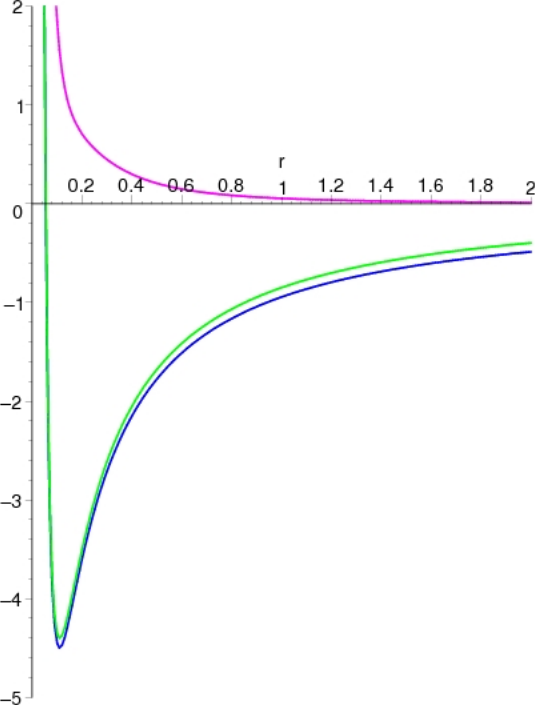
The effective potential is plotted for two different Yukawa
potentials. Blue corresponds to the ordinary Coulomb potential
\(\alpha=0\), green corresponds to \(\alpha={10}\), and magenta
corresponds to \(\alpha=\frac{1}{10}\).
Notice that for \(\alpha=\frac{1}{10}\) there is no possibility of
bound orbits, including stable circular orbits, because there is no
minimum value to the potential.