Central Forces: Spring-2026
HW 01 (SOLUTION): Due W1 D3: Math Bits
- Syllabus and Schedule
S1 5530S
Find the course syllabus and schedule on Canvas. Read through them carefully and bring your questions to the second day of class.
- Compare Fourier Series to Particle-in-a-Box
S1 5530S
Consider the function:
\begin{equation*}
f(x)=\begin{cases}
0&0<x<\frac{L}{3}\\
D & \frac{L}{3}<x<\frac{2L}{3}\\
0&\frac{2L}{3}<x<L
\end{cases}
\end{equation*}
You can think of this function as periodic, with period \(L\). Expand this function in a Fourier series.
Plot an approximation containing eight nonzero terms.
Make a histogram of your coefficients. Be thoughtful about the horizontal axis of your histogram.
This function is even, so I'm expecting that all the coefficients in front of sine functions (\(b_n\)'s) to be zero: \begin{align*} b_n &= \frac{2}{L} \int_0^L \sin\left(\frac{2n \pi x}{L}\right) f(x) dx\\ &= \frac{2}{L}\Bigg[ \int_0^{L/3} (0) dx + \int_{L/3}^{2L/3} D\sin\left(\frac{2n \pi x}{L}\right)dx + \int_{2L/3}^L (0) dx \Bigg]\\ &= \frac{D}{n\pi} \Bigg[ \cos\left(\frac{2n\pi}{3} \right) -\cos\left(\frac{4n\pi}{3} \right)\Bigg]\\ &= 0 \end{align*}
Convince yourself that this is zero by looking at the unit circle: \begin{align*} \cos\left(\frac{2\pi}{3} \right) -\cos\left(\frac{4\pi}{3}\right) &= 0 \\ \cos\left(\frac{4\pi}{3} \right) -\cos\left(\frac{8\pi}{3}\right) &= 0 \\ \cos\left(\frac{6\pi}{3} \right) -\cos\left(\frac{12\pi}{3}\right) &= 0 \\ \end{align*}
and so on. Now, now I'll look at the coefficients of the cosine terms: \begin{align*} a_0 &= \frac{2}{L} \int_0^L f(x) dx\\ &= \frac{2}{L}\Bigg[ \int_0^{L/3} (0) dx + \int_{L/3}^{2L/3} D dx + \int_{2L/3}^L (0) dx \Bigg]\\ &= \frac{D}{3} \end{align*} \begin{align*} a_n &= \frac{2}{L} \int_0^L \cos\left(\frac{2n \pi x}{L}\right) f(x) dx\\ &= \frac{2}{L}\Bigg[ \int_0^{L/3} (0) dx + \int_{L/3}^{2L/3} D\cos\left(\frac{2n \pi x}{L}\right) dx + \int_{2L/3}^L (0) dx \Bigg]\\ &= \frac{D}{n\pi} \Bigg[ -\sin\left(\frac{2n\pi}{3} \right) +\sin\left(\frac{4n\pi}{3} \right)\Bigg]\\ \end{align*}
So, for: \begin{align*} a_1 &= -\frac{D\sqrt{3}}{\pi} \\ a_2 &= \frac{D\sqrt{3}}{2\pi} \\ a_3 &= 0 \\ a_4 &= -\frac{D\sqrt{3}}{4\pi} \\ a_5 &= \frac{D\sqrt{3}}{5\pi} \\ a_6 &= 0 \\ a_7 &= -\frac{D\sqrt{3}}{7\pi} \\ a_8 &= \frac{D\sqrt{3}}{8\pi} \\ a_9 &= 0 \\ a_{10} &= -\frac{D\sqrt{3}}{10\pi} \\ \end{align*}
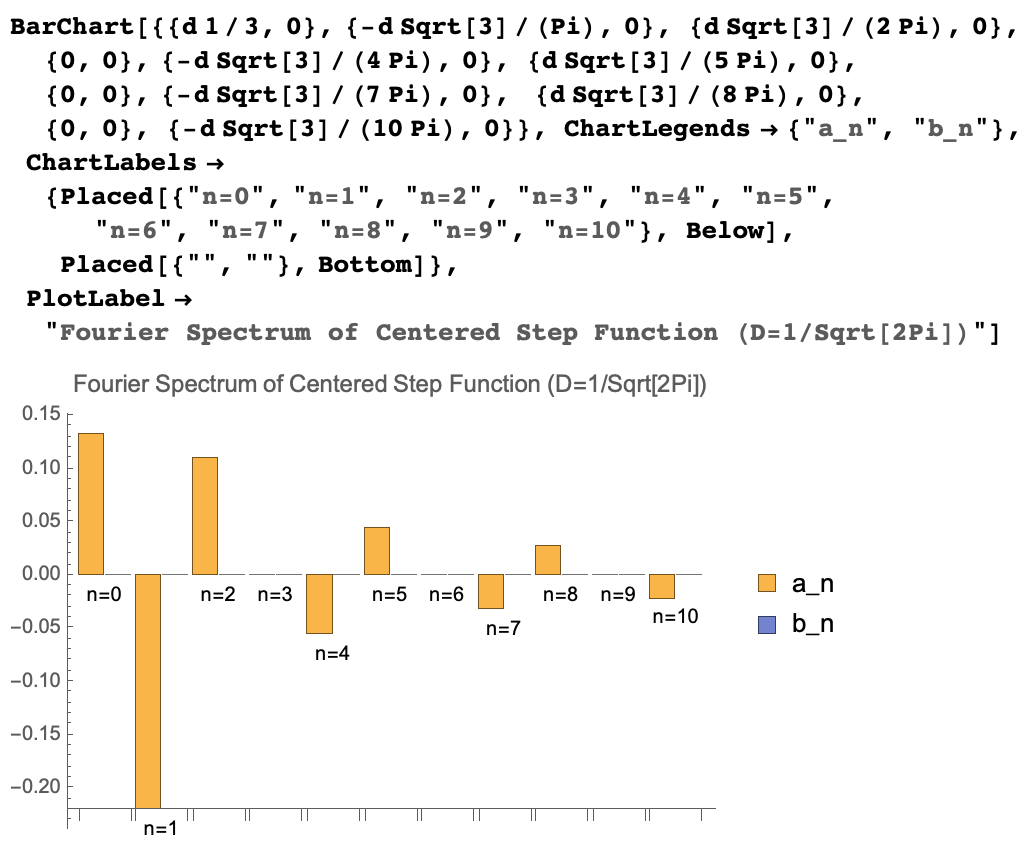
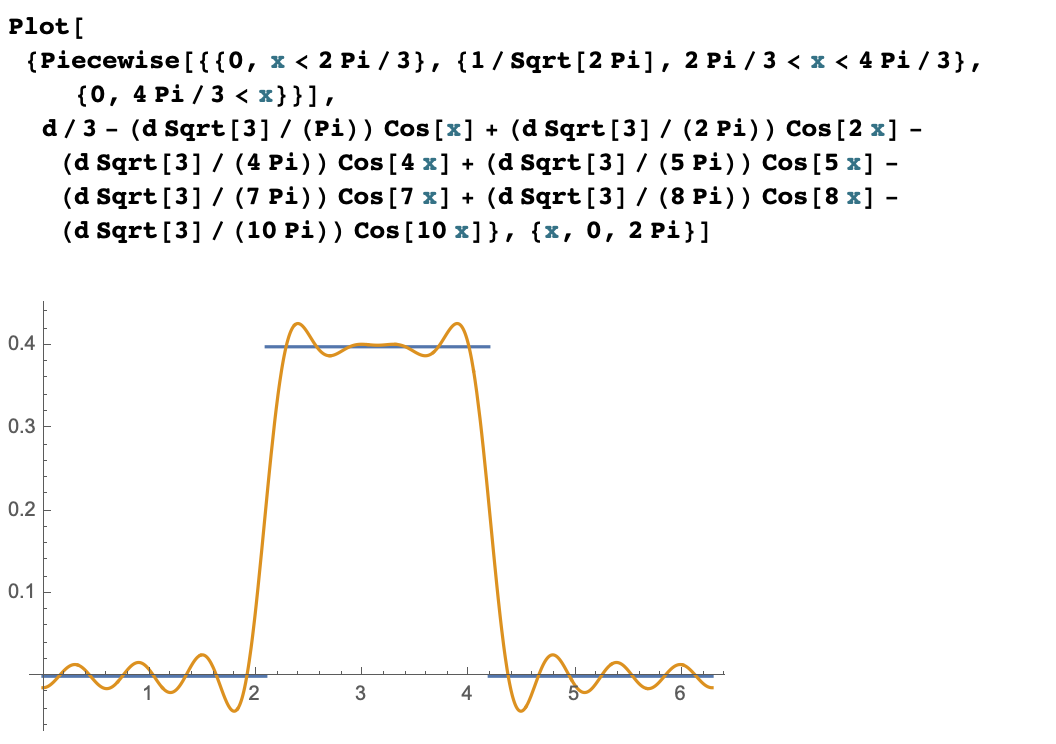
Extra Credit Challenge You can also think of this function as representing a quantum particle in a box of size \(L\). Expand this function in quantum particle in a box energy eigenstates.
Plot an approximation containing eight nonzero terms.
Make a histogram of your coefficients. Be thoughtful about the horizontal axis of your histogram.
Now I'm going to approximate this function using the energy eigenstates of the infinite square well: \begin{align*} \left|{f}\right\rangle = \sum_{n=0}^{\infty} c_n \left|{n}\right\rangle \end{align*}
where \(\left|{n}\right\rangle \) are the energy eigenstates of the infinite square well (ISW). In wavefunction language, this is: \begin{align*} f(x) = \sum_{n=0}^{\infty} c_n \sqrt{\frac{2}{L}} \sin \left(\frac{n \pi x}{L}\right) \end{align*}
So, now I have two different ways to write the same function!: \begin{align*} &\mbox{Piecewise: } f(x) =\begin{cases} 0&0<x<\frac{L}{3}\\ D & \frac{L}{3}<x<\frac{2L}{3}\\ 0&\frac{2L}{3}<x<L \end{cases}\\ &\mbox{ISW Energy Eigenstates: } f(x) = \sum_{n=0}^{\infty} c_n \sqrt{\frac{2}{L}} \sin \left(\frac{n \pi x}{L}\right)\\ \end{align*}
To find the expansion coefficients for the ISW Energy Eigenstate form, I'll take advantage of the orthonormality of the energy eigenstates \(\left|{n}\right\rangle \) and do inner products: \begin{align*} c_n &= \left\langle {n}\middle|{f}\right\rangle \\ &= \int_0^{L} \sqrt{\frac{2}{L}}\sin\left(\frac{n\pi x}{L}\right) f(x) dx\\ \end{align*}
where I will use the piecewise definition of \(f(x)\) inside the integral. This seems circular - using \(f(x)\) to calculate the coefficients for representing \(f(x)\) - but I need information about the function in order to figure out the unique expansion coefficients for this function. Now I'll plug in my original \(f(x)\) and integrate: \begin{align*} c_n &= \int_0^{L/3} (0) dx + \int_{L/3}^{2L/3} D\sqrt{\frac{2}{L}}\sin\left(\frac{n\pi x}{L}\right) dx + \int_{2L/3}^{L} (0) dx\\ &= \int_{L/3}^{2L/3} D\sqrt{\frac{2}{L}}\sin\left(\frac{n\pi x}{L}\right) dx\\ &= -\frac{DL}{n\pi}\sqrt{\frac{2}{L}}\cos\left(\frac{n\pi x}{L}\right)\Bigg|_{L/3}^{2L/3} \\ &= -\frac{D\sqrt{2L}}{n\pi}\Big[\cos \left(\frac{2n\pi}{3}\right)- \cos \left(\frac{n\pi}{3}\right) \Big] \\ \end{align*}
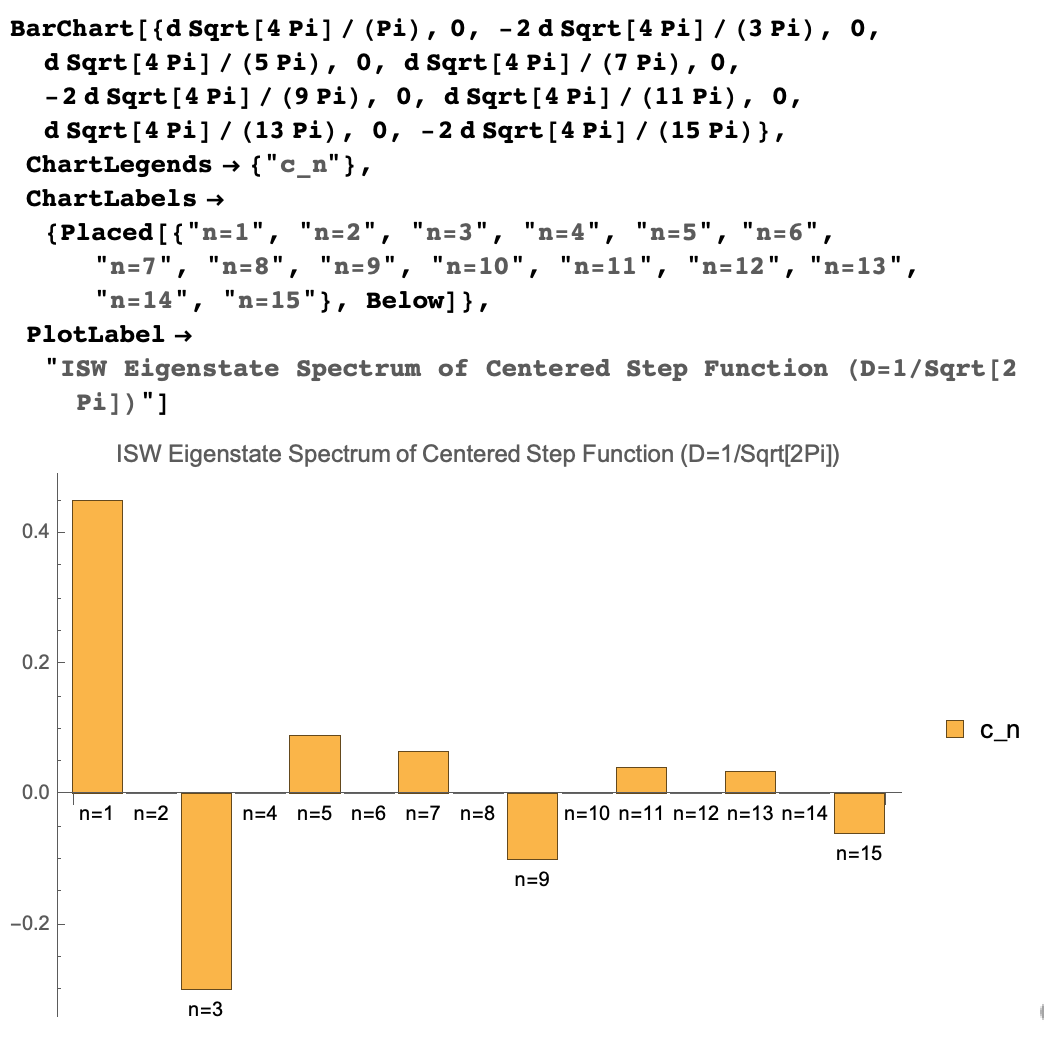
Because this Center Step function is symmetric in my well, I expect only contributions from terms that are symmetric in the well - only odd \(n\). All the even \(n\) terms are assymmetric in the well. Plugging in for integer \(n\): \begin{align*} c_1 &= \frac{D\sqrt{2L}}{\pi} \\ c_2 &= 0 \\ c_3 &= -\frac{2D\sqrt{2L}}{3\pi} \\ c_4 &= 0 \\ c_5 &= \frac{D\sqrt{2L}}{5\pi}\\ c_6 &= 0 \\ c_7 &= \frac{D\sqrt{2L}}{7\pi}\\ c_8 &= 0 \\ c_9 &= -\frac{2D\sqrt{2L}}{9\pi}\\ c_{10} &= 0\\ c_{11} &= \frac{D\sqrt{2L}}{11\pi}\\ c_{12} &= 0\\ c_{13} &= \frac{D\sqrt{2L}}{13\pi}\\ c_{14} &= 0\\ c_{15} &= -\frac{2D\sqrt{2L}}{15\pi}\\ \end{align*}
As expected, all the \(n=\) even terms are zero. The spectrum looks like:
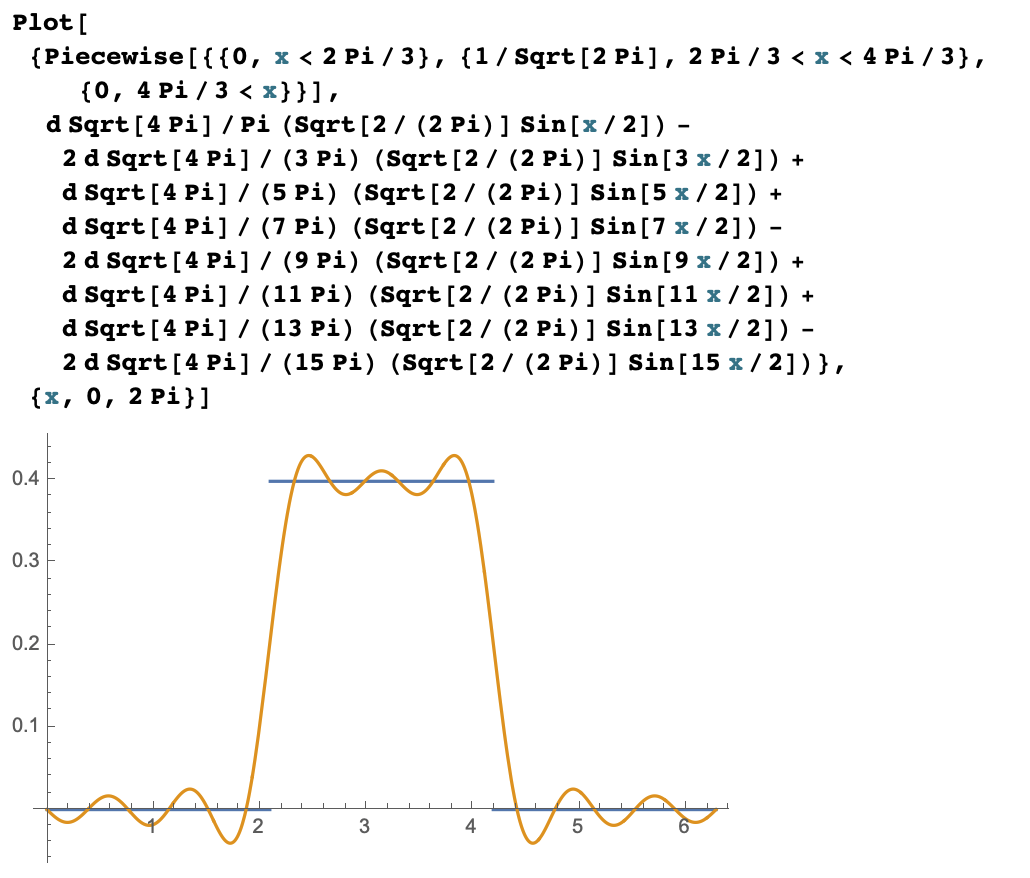
The approximation looks like: \begin{align*} f(x) &\approx \frac{D\sqrt{2L}}{\pi} \sqrt{\frac{2}{L}}\sin\left(\frac{\pi x}{L}\right) -\frac{2D\sqrt{2L}}{3\pi} \sqrt{\frac{2}{L}}\sin\left(\frac{3\pi x}{L}\right)\\ & +\frac{D\sqrt{2L}}{5\pi} \sqrt{\frac{2}{L}}\sin\left(\frac{5\pi x}{L}\right) +\frac{D\sqrt{2L}}{7\pi} \sqrt{\frac{2}{L}}\sin\left(\frac{7\pi x}{L}\right) \\ & -\frac{2D\sqrt{2L}}{9\pi} \sqrt{\frac{2}{L}}\sin\left(\frac{9\pi x}{L}\right) +\frac{D\sqrt{2L}}{11\pi} \sqrt{\frac{2}{L}}\sin\left(\frac{11\pi x}{L}\right) \\ & +\frac{D\sqrt{2L}}{13\pi} \sqrt{\frac{2}{L}}\sin\left(\frac{13\pi x}{L}\right) -\frac{2D\sqrt{2L}}{15\pi} \sqrt{\frac{2}{L}}\sin\left(\frac{15\pi x}{L}\right) \\ \end{align*}
- Extra Credit Challenge: Briefly reflect on the similarities and differences between the previous two cases. You may find it interesting to plot your approximations from \(x=-2L\) to \(x=2L\)
I have three different ways to write the same function!: \begin{align*} &\mbox{Piecewise: } f(x) =\begin{cases} 0&0<x<\frac{L}{3}\\ D & \frac{L}{3}<x<\frac{2L}{3}\\ 0&\frac{2L}{3}<x<L \end{cases}\\ &\mbox{Fourier Series: } f(x) = \frac{a_0}{2} + \sum_{n=0}^{\infty} a_n \cos \left(\frac{2 \pi n x}{L}\right) + \sum_{n=0}^{\infty} b_n \sin \left(\frac{2 \pi n x}{L}\right)\\ &\mbox{ISW Energy Eigenstates: } f(x) = \sum_{n=0}^{\infty} c_n \sqrt{\frac{2}{L}}\sin \left(\frac{n \pi x}{L}\right)\\ \end{align*}
This problem has me expanding function my piecewise-defined \(f(x)\) in two completely different sets of basis functions: Fourier Series and the energy eigenstates of the infinite square well.
The Fourier expansion includes a constant term (\(n=0\)) and cosine terms - no sine terms.
The ISW energy basis only includes sine terms - no constant term and no cosine terms.
Therefore, even though it's tempting to think of the ISW energy basis and the Fourier functions to be the same, they really aren't.
If I include 8 terms each, the approximations look pretty similar, but I needed \(n=15\) in order to get 8 non-zero terms for the ISW energy basis. For the Fourier Series, I only need \(n=10\).
I'll plot what my expansion looks like outside of \(0<x<L\):
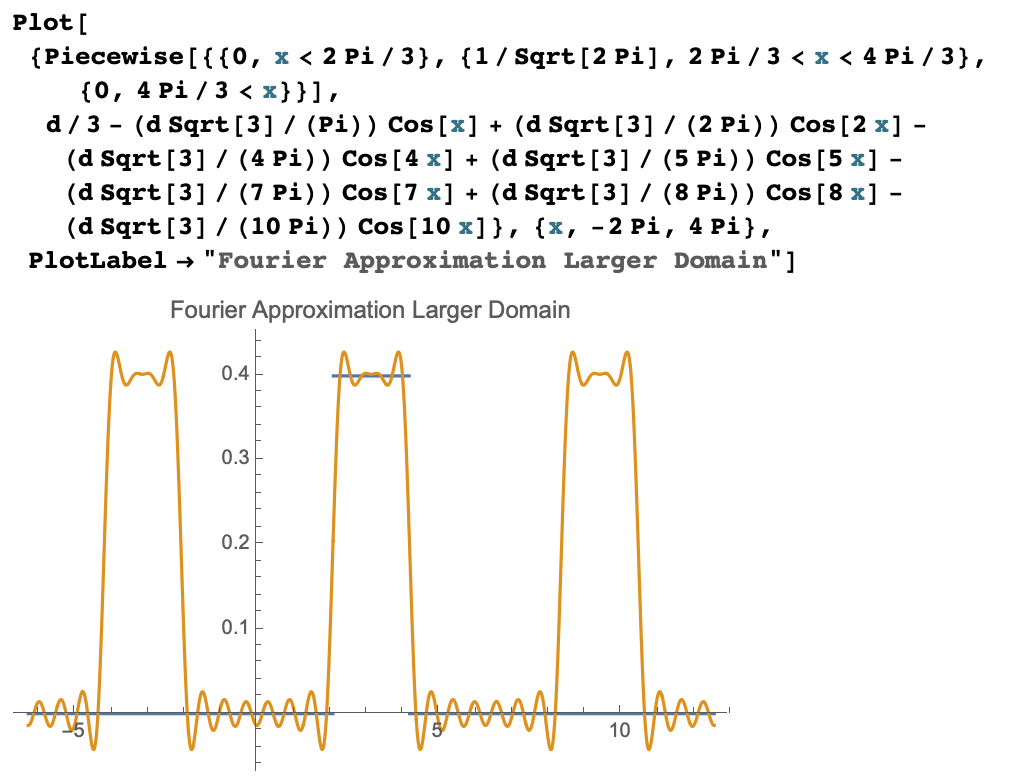
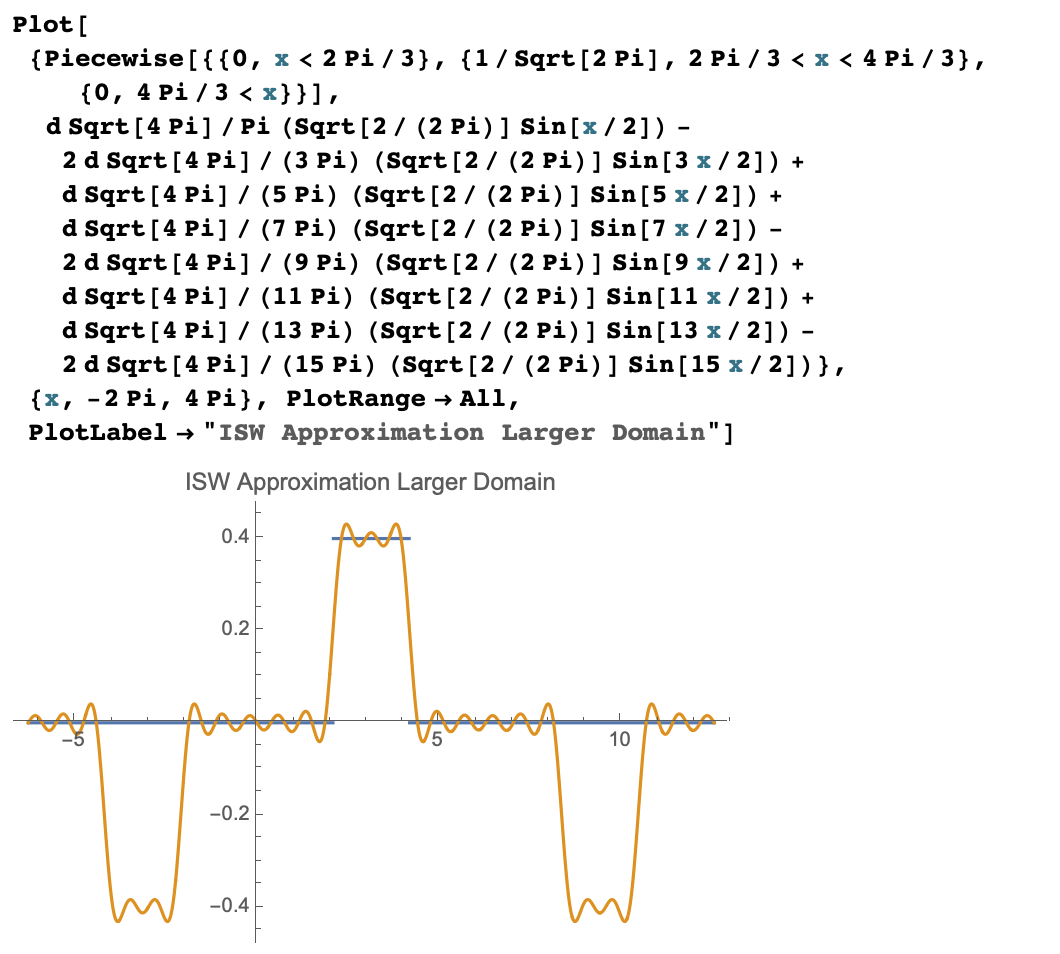
Notice that the Fourier approximation repeats the same, but the ISW energy approximation alternates signs.