Quantum Fundamentals: Winter-2024
Complex Number Practice : Due Day 4 Th 2/15 Math Bits
- Complex Arithmetic: Rectangular Form
S0 4959S
For the complex numbers \(z_1=3-4i\) and \(z_2=7+2i\), compute:
- \(z_1-z_2\)
- \(z_1 \, z_2\)
- \(\frac{z_1}{z_2}\)
- Circle Trigonometry and Complex Numbers
S0 4959S
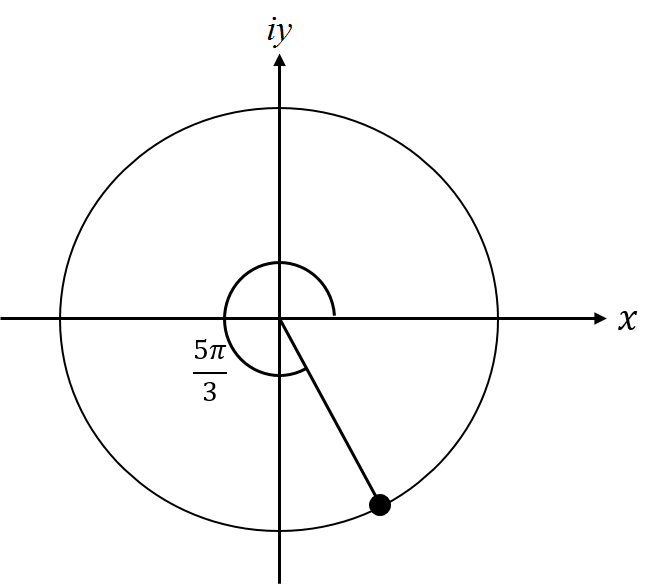
Find the rectangular coordinates of the point where the angle \(\frac{5\pi}{3}\) meets the unit circle. If this were a point in the complex plane, what would be the rectangular and exponential forms of the complex number? (See figure.)
- Complex Number Algebra, Exponential to Rectangular--Practice
S0 4959S
If \(z_1=5e^{7i\pi/4}\), \(z_2=3e^{-i\pi/2}\), and \(z_3=9e^{(1+i\pi)/3}\), express each of the following complex numbers in rectangular form, i.e. in the form \(x+iy\) where \(x\) and \(y\) are real.
- \( z_1 +z_2 \)
- \( z_1 z_2 \)
- \( \frac{z_2}{z_3} \)
- Complex Numbers, All Forms--Practice
S0 4959S
Represent the following four complex numbers in rectangular form \(a + ib\),
exponential form \(|z|e^{i\phi}\) , and on an Argand diagram:
\(e^{i\pi}\)
\(i\)
\(\sin\frac{\pi}{2}\)
- \(\cos\frac{\pi}{4}-i\sin\frac{\pi}{4}\)
- Exponential Form of Complex Numbers--Practice
S0 4959S
For each of the following complex numbers \(z\), find \(z^2\), \(\vert z\vert^2\), and rewrite \(z\) in exponential form, i.e. as a magnitude times a complex exponential phase:
\(z_1=i\),
\(z_2=2+2i\),
- \(z_3=3-4i\).
- Complex Number Algebra--Practice
S0 4959S
Express each of the following complex numbers in rectangular form, i.e. in the form \(x+iy\) where \(x\) and \(y\) are real.
- \(3e^{2(1+i\pi)}\)
- \(3e^{i\pi}+3e^{-i\pi}\)
- \((1-i)^8\)
- \(\left(1+i\sqrt{3}\right)^{6}\)
- \(\frac{2+3i}{1-i}\)
- Graphs of the Complex Conjugate
S0 4959S
For each of the following complex numbers, determine the complex conjugate, square, and norm. Then, plot and clearly label each \(z\), \(z^*\), and \(|z|\) on an Argand diagram.
- \(z_1=4i-3\)
- \(z_2=5e^{-i\pi/3}\)
- \(z_3=-8\)
- In a few full sentences, explain the geometric meaning of the complex conjugate and norm.