Theoretical Mechanics: Fall-2026
HW 1 (SOLUTION): Due W Day 6 MathBits
- Angles from the Dot Product
S1 5342S
Let \begin{align*} \boldsymbol{\vec a} &= \boldsymbol{\hat x}-3\boldsymbol{\hat y}-\boldsymbol{\hat z}\\ \boldsymbol{\vec b} &= \boldsymbol{\hat x}+\boldsymbol{\hat y}+2\boldsymbol{\hat z}\\ {\boldsymbol{\vec c}} &= -2\boldsymbol{\hat x}-\boldsymbol{\hat y}+\boldsymbol{\hat z}\\ \boldsymbol{\vec d} &= -\boldsymbol{\hat x}-\boldsymbol{\hat y}+\boldsymbol{\hat z} \end{align*}
Use the dot product to determine: Which pairs of these vectors (if any)
- Are perpendicular?
- Are parallel?
- Have an angle less than \(\pi/2\) between them?
- Have an angle of more than \(\pi/2\) between them?
Since \[\boldsymbol{\vec a}\cdot\boldsymbol{\vec b} =|\boldsymbol{\vec a}| |\boldsymbol{\vec b}|\cos\theta\] the sign of the dot product tells you whether the angle \(\theta\) between \(\boldsymbol{\vec a}\) and \(\boldsymbol{\vec b}\) is less than \(\pi/2\) (positive dot product), \(\pi/2\) (vanishing dot product), or greater than \(\pi/2\) (negative dot product).
Computing dot products, we have \begin{align*} \boldsymbol{\vec a}\cdot\boldsymbol{\vec b}&=-4,\\ \boldsymbol{\vec a}\cdot\boldsymbol{\vec c}&=0,\\ \boldsymbol{\vec a}\cdot\boldsymbol{\vec d}&=1,\\ \boldsymbol{\vec b}\cdot\boldsymbol{\vec c}&=-1,\\ \boldsymbol{\vec b}\cdot\boldsymbol{\vec d}&=0,\\ \boldsymbol{\vec c}\cdot\boldsymbol{\vec d}&=4.\\ \end{align*}
So \(\boldsymbol{\vec a}\perp\boldsymbol{\vec c}\), \(\boldsymbol{\vec b}\perp\boldsymbol{\vec d}\). The angles between \(\boldsymbol{\vec d}\) and both \(\boldsymbol{\vec a}\) and \(\boldsymbol{\vec c}\) are less than \(\pi/2\), and the angles between \(\boldsymbol{\vec b}\) and both \(\boldsymbol{\vec a}\) and \(\boldsymbol{\vec c}\) are more than \(\pi/2\). None of the vectors are parallel, since none are scalar multiples of each other. (Alternatively, compute the cross products, and show that they are all nonzero.)
- Tetrahedron
S1 5342S
Using a dot product, find the angle between any two line segments that join the center of a regular tetrahedron to its vertices. Hint: Think of the vertices of the tetrahedron as sitting at the vertices of a cube (at coordinates (0,0,0), (1,1,0), (1,0,1) and (0,1,1)---you may need to build a model and play with it to see how this works!)
Think of one of the vertices of the tetrahedron lying at the origin, and the other vertices at \((1,1,0)\), \((1,0,1)\), and \((0,1,1)\). The center of the tetrahedron is at \((\frac{1}{2}, \frac{1}{2}, \frac{1}{ 2})\).
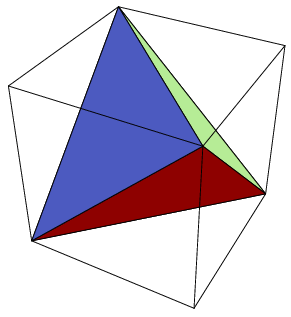
Consider two vectors each pointing from the center of the tetrahedron to one of the vertices (say the first two on the list above) \begin{align} \vec{v}_1 &=\left[ (1\hat x + 1\hat y+0\hat{z})-\Big(\frac{1}{2} \hat x + \frac{1}{2} \hat y + \frac{1}{2}\hat z\Big)\right]\\ \vec{v}_2 &= \left[(1\hat x + 0\hat{y} +1 \hat z)-\Big(\frac{1}{2} \hat x + \frac{1}{2} \hat y + \frac{1}{2}\hat z\Big)\right] \end{align}
Then we can calculate the dot product of these two vectors in two ways: algebraically (on the left) and geometrically (on the right).
\begin{align*} \left[ (\hat x + \hat y)-\Big(\frac{1}{2} \hat x + \frac{1}{2} \hat y + \frac{1}{2}\hat z\Big)\right] &\cdot \left[(\hat x + \hat z)-\Big(\frac{1}{2} \hat x + \frac{1}{2} \hat y + \frac{1}{2}\hat z\Big)\right]\\ &= \left\vert \frac{1}{2} \hat x +\frac{1}{2} \hat y -\frac{1}{2}\hat z\right\vert\left\vert \frac{1}{2} \hat x -\frac{1}{2} \hat y+\frac{1}{2}\hat z\right\vert\cos \gamma\\ \left(\frac{1}{2} \hat x +\frac{1}{2} \hat y -\frac{1}{2}\hat z\right) \cdot\left(\frac{1}{2} \hat x -\frac{1}{2} \hat y+\frac{1}{2}\hat z\right) &= \sqrt{\frac{3}{4}} \sqrt{\frac{3}{4}} \cos\gamma\\ -\frac{1}{4} &= \frac{3}{4} \cos\gamma\\ \cos\gamma &= -\frac{1}{3}\\ \gamma &= \cos^{-1}\left( -\frac{1}{3}\right)\\ &\approx 109.5^o \end{align*}
This tetrahedral angle is a good approximation to the angle in a water molecule \(H_2O\), although there is lots of great chemistry/physics that goes into why the actual angle in water is somewhat less.
Sensemaking: This angle is part of a triangle, so it should be less than \(180^o\). Because the two vertices of a tetrahedron are farther apart than two vertices of the cube that are adjacent to each other, the angle should be bigger than that one, which is about \(70.5^o\) (you can find this one using the same method as above!). You might also convince yourself that the triangle must be an obtuse isosceles one, as the length of each vector from the center to a vertex is \(\sqrt{3/4}\), while the length of the last leg of the triangle is \(\sqrt{2}\), which is just bigger than the value you would get from using the Pythagorean theorem as if it were a right triangle (\(\sqrt{3/2}\)).
- Graphs Involving the Distance Formula
S1 5342S
Learn more about the geometry of \(\vert \vec{r}-\vec{r'}\vert\) in two dimensions.
-
Make sketches of the following functions, by hand, on the same
axes:
\begin{align*}
y &= \sin x\\
y &= \sin(x+2)
\end{align*}
Briefly describe the role that the number 2 plays in the
shape of the second graph
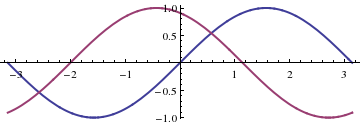
Both curves are shown above. The blue curve (through the origin) is \(y=\sin x\); The purple curve is \(y=\sin(x+2)\), which is shifted 2 units to the left. Adding 2 to the argument of a function shifts it two units toward the negative side of the axis for the independent variable. Make a sketch of the graph \begin{equation*} \vert \vec{r} - \vec{a} \vert = 2 \end{equation*}
for each of the following values of \(\vec a\): \begin{align*} \vec a &= \vec 0\\ \vec a &= 2 \hat x- 3 \hat y\\ \vec a &= \text{points due east and is 2 units long} \end{align*}
The formula \(\vert \vec{r}\vert=2\) says to find all the position vectors whose length is 2. The set of points equidistant from the same point form a circle. Just as the transformation \(f(x)\rightarrow f(x-2)\) shifts the graph of \(f(x)\) by two units to the right, the transformation \(\vert \vec{r}\vert \rightarrow \vert \vec{r}-\vec{a}\vert\) shifts the graph to the endpoint of the vector \(\vec{a}\). The formula \(\vert \vec{r} - \vec{a} \vert = 2\) says find the set of points that are all at a distance two from the end of the position vector \(\vec{a}\).
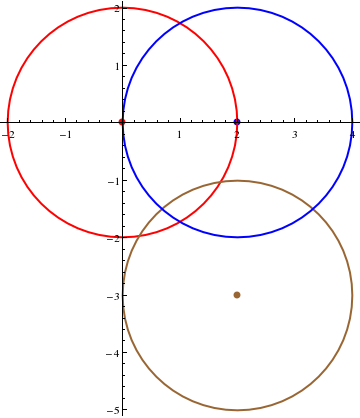
All three circles are shown above, together with their centers, at \((0,0)\) (red), \((2,-3)\) (brown), and \((2,0)\) (blue), respectively.-
Derive a more familiar equation equivalent to
\begin{equation*}
\vert \vec r - \vec a \vert = 2
\end{equation*}
for arbitrary \(\vec a\), by expanding \(\vec r\) and \(\vec a\) in
rectangular coordinates. Simplify as much as possible. (Ok, ok, I
know this is a terribly worded question. What do I mean by “more
familiar"? What do I mean by “simplify as much as possible"? Why am
I making you read my mind? Try it anyway. Real life is not full of
carefully worded problems. Bonus points to anyone who can figure
out a better way of wording the question that doesn't give the point
away.)
Let \begin{align*} \vec{r} &= r_{x}\,\hat{x}+r_{y}\,\hat{y}\\ \vec{a} &= a_{x}\,\hat{x}+a_{y}\,\hat{y}\\ \vec{r}-\vec{a} &=(r_{x}\,\hat{x}+r_{y}\,\hat{y}) -(a_{x}\,\hat{x}+a_{y}\,\hat{y})\\ &= (r_x-a_x)\,\hat{x}+(r_y-a_y)\,\hat{y} \end{align*}
The magnitude of a vector is the square root of the dot product of the vector with itself. Therefore, \begin{align*} \vert \vec{r}-\vec{a} \vert &= \sqrt{(\vec{r}-\vec{a})\cdot(\vec{r}-\vec{a})}\\ &= \sqrt{[(r_{x}-a_{x})\hat{x}+(r_{y}-a_{y})\hat{y}] \cdot [(r_{x}-a_{x})\hat{x}+(r_{y}-a_{y})\hat{y}]}\\ &= \sqrt{(r_{x}-a_{x})^{2}+(r_{y}-a_{y})^{2}} \end{align*} So: \begin{align*} \vert \vec r - \vec a \vert &= 2\\ &\Rightarrow \sqrt{(r_{x}-a_{x})^2+(r_{y}-a_{y})^2}= 2\\ &\Rightarrow(r_{x}-a_{x})^2+(r_{y}-a_{y})^2 = 4 \end{align*}
which is the equation for a circle written in Cartesian coordinates.
-
Write a brief description of the geometric meaning of the equation
\begin{equation*}
\vert \vec r - \vec a \vert = 2
\end{equation*}
This equation says to find the position vectors \(\vec{r}\) that are the distance 2 from the end of the position vector \(\vec{a}\). These points form a circle with radius 2 (the right-hand side of the equation) and centered at \(\vec{a}\).
-
Make sketches of the following functions, by hand, on the same
axes:
\begin{align*}
y &= \sin x\\
y &= \sin(x+2)
\end{align*}
Briefly describe the role that the number 2 plays in the
shape of the second graph