Theoretical Mechanics: Fall-2021
Practice Power Series (SOLUTION): Due Day 14
- Power Series Practice
S1 4094S
- Calculate the \(n=0, 1, 2, 3, 4\) coefficients of the power series for \(\cos{z}\) expanded around \(z=\pi\). Using these coefficients, find a power series approximation for this function.
First, the form of the answer will be: \[ \cos z \approx c_0 + c_1 (z-\pi) + c_2 (z-\pi)^2 + c_3(z-\pi)^3 + c_4(z-\pi)^4\] or \[ \cos z = c_0 + c_1 (z-\pi) + c_2 (z-\pi)^2 + c_3(z-\pi)^3 + c_4(z-\pi)^4+\dots\]
Because I'm asked for the fourth order expansion, I'll keep only terms up to the fourth power. I use the first form (with the \(\approx\) approximation sign and stopping at the fourth order term) when I want to emphasize that I have done an approximation. Ise the second form (with an \(=\) sign and \(\dots\) at the end) when I want to indicate that there are more terms that I am not writing in the exact power series.
Now, to calculate the coefficients: \begin{eqnarray*} c_0 &=& \frac{1}{0!}f(z=z_0) = \cos\pi = -1 \\ c_1 &=& \frac{1}{1!}\left.\frac{df}{dz}\right|_{z=z_0} = -\sin \pi = 0 \\ c_2 &=& \frac{1}{2!}\left.\frac{d^2f}{dz^2}\right|_{z=z_0} = -\frac{1}{2}\cos \pi = \frac{1}{2} \\ c_3 &=& \frac{1}{3!}\left.\frac{d^3f}{dz^3}\right|_{z=z_0} = \frac{1}{6}\sin \pi = 0 \\ c_4 &=& \frac{1}{4!}\left.\frac{d^4f}{dz^4}\right|_{z=z_0} = \frac{1}{24}\cos \pi = -\frac{1}{24} \\ \end{eqnarray*} (Don't forget the \(1/n!\).)
So, the approximation I end up with is:
\[ \cos z \approx -1 + \frac{1}{2} (z-\pi)^2 +-\frac{1}{24}(z-\pi)^4\]
This formula is the correct form of the power serie approximation. Do NOT multiply out and regroup the terms (do Not "FOIL") or you are undoing all the work you did to find the power series.
- Plot both the original function and your approximation.
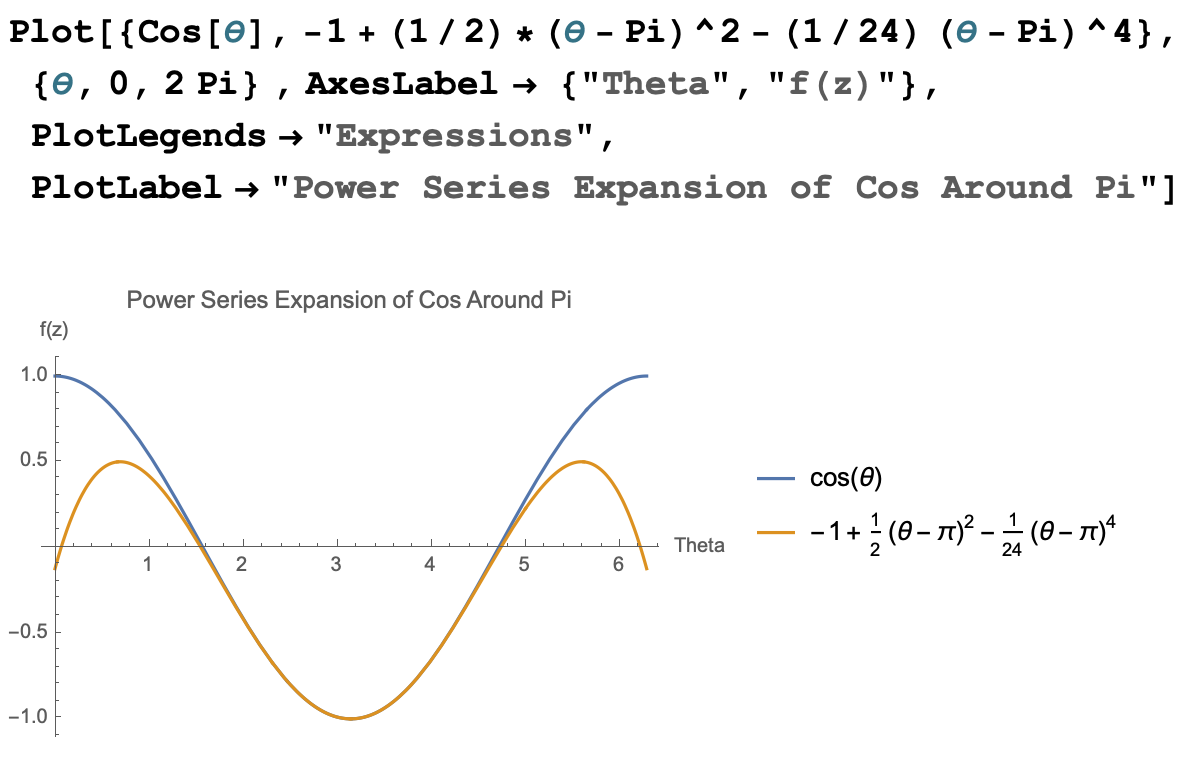
Here is the code in Mathematica and the graph it produces.
- For what values of \(z\) is your approximation “good”?
When I plot this approximation against the cosine function, I see that the expansion approximates the cosine function reasonably well between about \(\pi/2\) and \(3\pi/2\). Inside this region, I can not even distinguish the graphs from each other. Beyond that region, the function and its approximation rapidly start to differ.
- Calculate the \(n=0, 1, 2, 3, 4\) coefficients of the power series for \(\cos{z}\) expanded around \(z=\pi\). Using these coefficients, find a power series approximation for this function.