Contemporary Challenges: Spring-2025
HW Week 6 : Due 18 Friday
- Heat Pump
S0 5264S
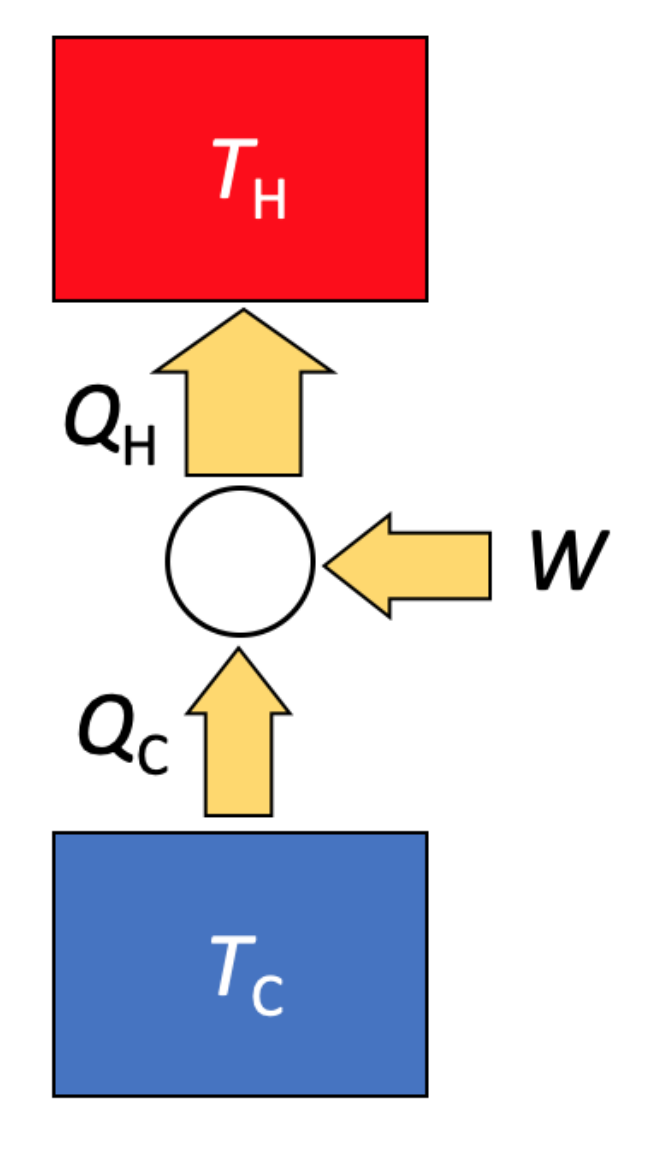
The diagram shows a machine (the white circle) that moves energy from a cold reservoir to a hot reservoir. We will consider whether a machine like this is useful for heating a family home in the winter when the temperature inside the family home is \(T_\text{H}\), and the temperature outside the house is \(T_\text{C}\). To quantify the performance of this machine, I'm interested in the ratio \(Q_\text{H}/W\), where \(Q_{\text{H}}\) is the heat energy entering the house, and \(W\) is the net energy input in the form of work. (\(W\) is the energy I need to buy from the electricity company to run an electric motor). Starting from the 1\(^{\text{st}}\) and 2\(^\text{nd}\) laws of thermodynamics, find the maximum possible value of \(Q_\text{H}/W\). This maximum value of \(Q_\text{H}/W\) will depend solely on the ratio of temperatures \(T_\text{H}\) and \(T_\text{C}\).
Sensemaking: Choose realistic values of \(T_\text{H}\) and \(T_\text{C}\) to describe a family home on a snowy day. Based on your temperature estimates, what is the maximum possible value of \(Q_\text{H}/W\)?
- Water and air heat capacity
S0 5264S
In the last homework, you looked up the specific heat capacity of water and air (\(c_{\text{p,water}}\) = 4.2 J/(g.K) and \(c_{\text{p,air}}\) = 1.0 J/(g.K)) to analyze changes in the earth's climate. In this problem, you'll estimate \(c_{p\text{,water}}\) and \(c_{p\text{,air}}\) from first principles. Note: You'll use the equipartition theorem which is a coarse-grained alternative to using the full machinary of statistical mechanics, so, the answers might be off by a few %.
- For liquid water at room temperature, treat every oxygen atom and hydrogen atom as a point mass held in place by a 3-dimensional network of springs (like an Einstein solid). These “springs” arise from intra-molecular bonds (bonds within an H\(_2\)O molecule) and inter-molecular forces (the forces between neighboring H\(_2\)O molecules). Assume 1 gram of water and calculate the total number of degrees of freedom. Then find the total internal energy as a function of temperature, and the specific heat capacity at constant volume. Compare with measured value of \(c_{\text{p,water}}\). Note: Liquid water doesn't expand/contract very much when heated, so \(c_{\text{p,water}} \approx c_{\text{v,water}}\).
- The main components of air are nitrogen and oxygen. They are both diatomic gas molecules. You can model an O\(_2\) gas molecule, or N\(_2\) gas molecule, as two point masses connected by a stiff spring. The spring is so stiff that the energy quanta needed to excite the spring is bigger than \(k_{\text{B}}T/2\) when \(T\) = 300 K. Therefore, you can treat the spring like a rigid rod. Calculate the total number of degrees of freedom in 1 gram of air. Then find the total internal energy as a function of temperature, and the specific heat capacity at constant volume. Compare with measured value of \(c_{\text{v,air}} = 0.717\) J/(g.K). Note, \(c_{\text{p,air}}\) is about 40% higher than \(c_{\text{v,air}}\) because air held at constant pressure converts a sizable fraction of the heat into work when the gas expands.