Contemporary Challenges: Spring-2021
Homework 8: (including Term Project) : Due 29 Friday
- Planting Ideas for Your Term Project S0 4198S Read https://paradigms.oregonstate.edu/activity/722 carefully and start thinking of ideas for your term project. Be on the look-out for examples of rich-context problems in lecture notes and homework questions. [This problem is not graded].
- Two-layer model for estimating the Earth's temperature
S0 4198S
Two layers of plexiglass are surrounding the Earth. One layer is 5 km above sea level, the other layer is 10 km above sea level. These plexiglass layers have replaced the gaseous atmosphere. Both layers of plexiglass are transparent to the solar spectrum (wavelengths centered around 500 nm), but fully absorb the thermal radiation emitted from the surface of the Earth. The surface of the Earth absorbs \(70\%\) of the incident sunlight and reflects the rest. Assume that the Earth distributes the absorbed solar energy uniformly across its spherical surface, therefore, it has a uniform temperature, \(T_{\text{surf}}\). Every part of this system is in steady state, meaning, all temperatures are stable.
- Draw an energy flow diagram for this system with three boxes representing (i) the surface of the Earth, (ii) the first plexiglass layer, (iii) the second plexiglass layer. Draw arrows to represent energy transported by short-wavelength light (solar radiation centered around 500 nm) and long-wavelength light (earth glow centered around 10,000 nm). If energy is being exchanged in two directions, show this with two separate arrows.
- The surface of the earth has temperature \(T_{\text{surf}}\), the first plexiglass layer has temperature \(T_1\), and the second plexiglass layer has temperature \(T_2\). Treat these as unknowns (we will determine them in part c). Use the idea of balanced energy rates to write down a set of mathematical relationships relating \(T_{\text{surf}}\), \(T_1\) and \(T_2\). Other parameters that may appear in your expressions include:
\(\quad I_{\text{sun}}\), intensity of sunlight
\(\quad R_{\text{earth}}\), radius of Earth
\(\quad \sigma\), the Stefan-Boltzmann constant
Note: Remember that the absorption of Sunlight depends on the size of the earth's shadow, not on the surface area of the earth.
Note: The surface area of the plexiglass layers are almost equal to the surface area of the Earth (the difference is negligible). - Let \(I_{\text{sun}}= 1360\text{ J/(s m}^2\text{)}\) and solve for \(T_2\), \(T_1\) and \(T_{\text{surf}}\). Give your final answer in both kelvin and your preferred unit for describing air temperature.
- Webb sun shield
S0 4198S
The James Webb Space Telescope has a sun shield consisting of five layers. As a first approximation, assume that each layer is black, abosorbing all radiation that hits it, and radiating as a blackbody. Furthermore, assume the layers are large enough and close enough together that you can neglect edge effects, so that all energy radiated by one layer is absorbed by the next. Further, assume that the telescope itself is a black sphere that is much smaller in radius than the distance between it and the sun shield, which itself is much smaller than the width of the sun shield.
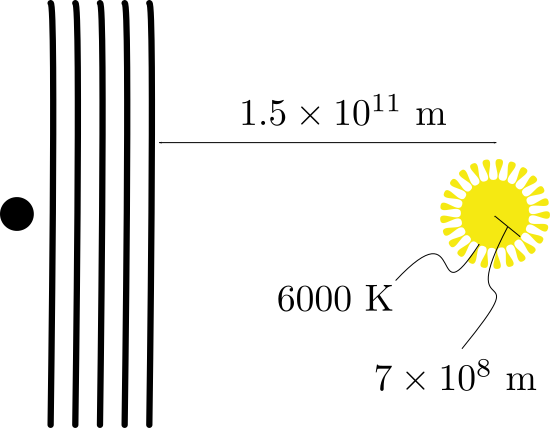
Once the system reaches steady state, what will the temperature of the telescope be under these assumptions?
Please start with the assumption that the visible surface of the sun is at 6000 K, and make use of the radius of the sun as well as our distance from the sun rather than simply assuming the known intensity of solar radiation. Specifically, I'd like your work to show how much the temperature drops at each stage (sun to first layer, first layer to second layer, etc).
Note
The actual sun shield is not black but rather very shiny. This question (for simplicity) considers a simple limiting case, which allows you to explore the importance of the shiny sun shield. It also allows us to avoid considering the geometry of multiple reflections. - Efficiency of a solar cell
S0 4198S
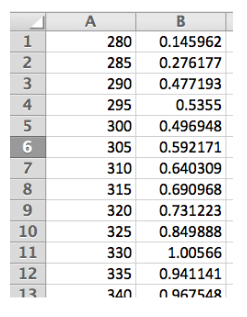
Download the file extraterr_solar.csv, which is in comma-separated-variable (csv) format. Open the csv file in a spreadsheet program such as Excel or Google Sheets. The data is the spectral intensity with respect to wavelength, \(S_\lambda\), for the sunlight that is hitting a satellite above the earth. The first column is wavelength in units of nanometers. The second column is spectral intensity in units of W/(m\(^2\cdot\)nm).
- Use a spreadsheet to perform a simple numerical integration (Riemann sum) to find the total energy flux hitting the satellite. Explain your method using summation notation. Additionally, write down the formula you enter in the spreadsheet (e.g. =SUM(B1:B745)). Give your final answer in units of W/m\(^2\) and check that it is reasonable.
Consider a narrow band of wavelengths, from 552.5 nm to 557.5 nm. (The bandwidth is 5 nm and the central wavelength is 555 nm). All the photons in this bandwidth have very similar energy, \(E_{\text{photon}} \approx\) (1240 nm\(\cdot\)eV)/(555 nm). How many photons per second per \(\text{m}^2\) are in this spectral band of sunlight? Explain your method using standard mathmeatical notation. Additionally, write down the formula that you entered into the spreadsheet.
The calculation that you did for part b can now be applied to every row in your spreadsheet. You will need these numbers for part c.
- Silicon solar cells absorb photons if \(E_{\text{photon}}> 1.1\text{ eV}\). That is to say, \(E_{\text{photon}}\) must be greater than gap between occupied and unoccupied quantum energy levels in silicon. Use your spreadsheet to calculate how many photons per second per \(\text{m}^2\) have sufficient energy to be absorbed by a solar cell. Write down the formula that you entered into the spreadsheet.
- The electrical energy produced by a silicon solar cell cannot exceed
\((1.1\text{ eV})\ \times\text{ (number of absorbed photons)}\).Calculate the maximum possible rate that electrical energy could be produced by a solar cell attached to this satellite per unit area. Give your answer in units of \(\text{W/m}^2\).
- Compare your answers to part a and part d. What is the maximum possible efficiency of the solar cell (i.e. the ratio of the electrical energy output to the total energy input)?