Contemporary Challenges: Spring-2021
Homework 5 : Due 18 Friday
- Miscellaneous
S0 4193S
- Adapted from T5B.8 Interstellar space has about one H\(_2\) molecule per cubic centimeter. The temperature of deep space is about 3 K. What is the pressure of this interstellar gas? How does it compare to the best vacuum we can achieve in the laboratory (\(\sim\) \(10^{-13}\) Pa)? How fast is the typical \(\text{H}_2\) molecule moving in interstellar space (average speed)?
- T5B.4 An atom of helium can store energy by bumping its electron from its lowest orbital energy level to a higher orbital energy level. In particular, moving an electron from the lowest state to the next-lowest state would store an energy of 24.6 eV (24.6 electron-volts). Explain why we can ignore this energy storage mode when calculating the heat capacity of helium gas at ordinary temperatures.
- (from T1T.12) Suppose we have two rigid containers, one holding \(N\) molecules of helium gas, and one holding \(N/2\) molecules of oxygen gas. Both are initially at room temperature. We then add the same amount of energy to each gas by heating. Which gas is hotter at the end?
- Two values of specific heat capacity
S0 4193S
If you google “specific heat capacity of air” you will find two values:
\begin{align}
c_{\text{p}}&= 1.00 \text{ kJ/kg\(\times\)K, at } T= 293\text{ K, }P= 1 \text{ atm}\\
c_{\text{v}}&= 0.72 \text{ kJ/kg\(\times\)K, at }T= 293\text{ K, }P= 1 \text{ atm}
\end{align}
The first value, \(c_\text{p}\), refers to the heat required to the raise the air temperature while holding pressure constant. The second value, \(c_\text{v}\), refers to the heat required to raise air the air temperature while holding volume constant. The goal of this question is to compare these published values to the physics we've learned so far. To simplify the question, treat the air as if it were pure nitrogen gas (the main component of air). Nitrogen gas has a density of 1.17 kg/m\(^3\) at \(T\) = 293 K and atmospheric pressure. The equation of state is \(pV= Nk_\text{B}T\). The internal energy of the gas is \(\frac52Nk_\text{B}T\).
- On a \(pV\) diagram, mark the initial state of the nitrogen gas (assume 1 kg of gas at 1 atm). On this same diagram, show how the state of the gas would change if heat was added while (i) keeping volume constant or (ii) keeping pressure constant.
- For the constant volume process, how much heat (in Joules) does it take to raise the temperature by 1 K? (Answer this question with 3 sig. fig. precision. When constructing your solution, don't refer to the published values of \(c_\text{p}\) or \(c_\text{v}\)).
- For the constant pressure process, how much heat (in Joules) does it take to raise the temperature by 1 K? (Answer this question with 3 sig. fig. precision. When constructing your solution, don't refer to the published values of \(c_\text{p}\) or \(c_\text{v}\)).
- Sensemaking: Do your calculations agree with published values?
- Hot showers and standard deviation
S0 4193S
(a) Estimate the energy used during a typical 10-minute shower in the United States. The dominant variables in this problem are the temperature rise of the water and the flow rate of the showerhead. Develop a coarse-grained model that incorporates these two variables. For simplicity, you may assume: (i) The water heater is 100% efficient at converting electrical energy into heat, and (ii) the water heater is located close to the shower, so heat losses in the pipes can be neglected.

(b) Develop a reasonable estimate for the standard deviation of your answer to part a. That is, imagine measuring the energy used for a 10-minute shower in a thousand randomly selected U.S. households. How much would the energy use vary? To develop a reasonable estimate, spend a little time doing internet research (or in-person research) on the variability of shower flow rates, the variability of ground temperature, and the variability of shower water temperature (personal preference). Once you can justify reasonable numbers for the variability of these inputs, propogate the uncertainty through your coarse-grained model using the methods we discussed in class.
(c) Sense making: Compare the typical energy used for a 10-minute shower to the typical energy used to drive an elecric car at 70 mph for 10 minutes.
- Thermal energy in the earth's atmosphere
S0 4193S
Thermal energy is stored in all materials on Earth, including the air, water and rocks. The air is composed mostly of diatomic molecules such as N\(_2\) and O\(_2\).
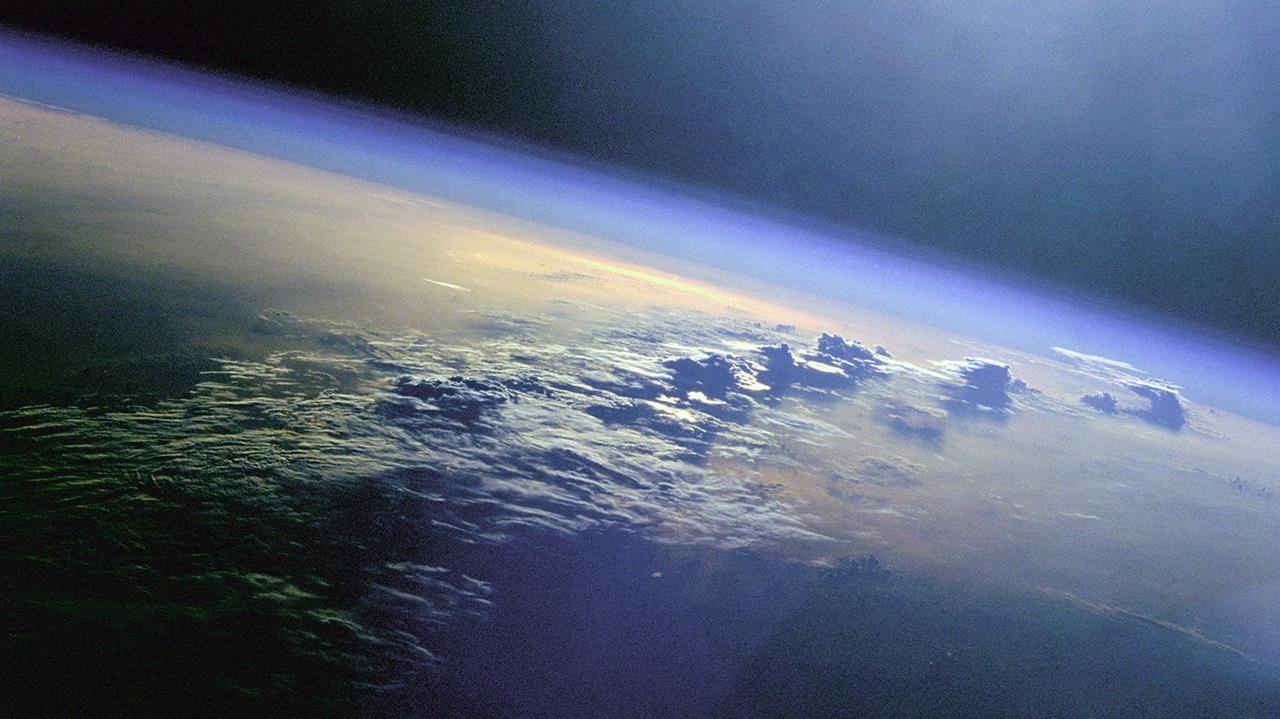
Use Google to look up the mass of the earth's atmosphere. Now, exercise some skepticism and make sure that Goggle's answer is consistent with other facts about the earth: Air pressure at sea level is about 100 kPa and the radius of the earth is about 6400 km. The air pressure at sea level (force per unit area) is caused by the downward force of gravity acting on the atmosphere directly above a unit area. The thickness of the atmosphere is much much less than the radius of the earth. Give your argument supporting or refuting the internet's value for the mass of the earth's atmosphere.
We know that between 1955 and 2010, the temperature of the top 2000 meters of the ocean rose by about 0.05 C. Given this fact, assess the validity of the following statement:
“If the same amount of heat that has gone into the top 2000 meters of the ocean between 1955-2010 had gone into the lower 10 km of the atmosphere, then the atmosphere would have warmed by about 20\(^\circ\)C (36\(^\circ\)F).”
Is this statement reasonable, or ridiculous? Show your calculations that support your conclusion. Your starting assumptions will include the specific heat capacity of air and water at constant pressure, and a reasonable guess regarding the fraction of the earth's surface that is covered with ocean.