Contemporary Challenges: Spring-2021
Homework 4 : Due 12 Friday
- Three ideas for the term project
S0 4191S
Read the description of the term project on the class website at “Introduction to term project”. Identify three (3) subjects that you find interesting/intriguing (for example, solar energy, exoplanets, ...). Within each subject, pose a question that might have an interesting quantitative answer: “Since it requires energy to make a solar panel, how long does it take to recoup that energy?”, “How far away could we see an Earth-like planet orbiting a Sun-like star?” ... You should turn in 3 different subjects and 3 different quantitative questions (quantitative means “quantities that can be calculated and/or measured”)
Let your mind wander as broadly as possible. Subjects and questions are not restricted to the topics taught in PH315. During this exploratory stage, be bold and daring; you are not committing yourself to solve all 3 questions. To spark your imagination, there is a list of ideas on the class website. The instructor will read your ideas and give you feedback. Whenever possible, the feedback will point you towards a coarse-grained model that is helpful for answering your question. Use the feedback to help decide which question you will develop further (or whether you need to go back to the drawing board).
- Heat Pump
S0 4191S
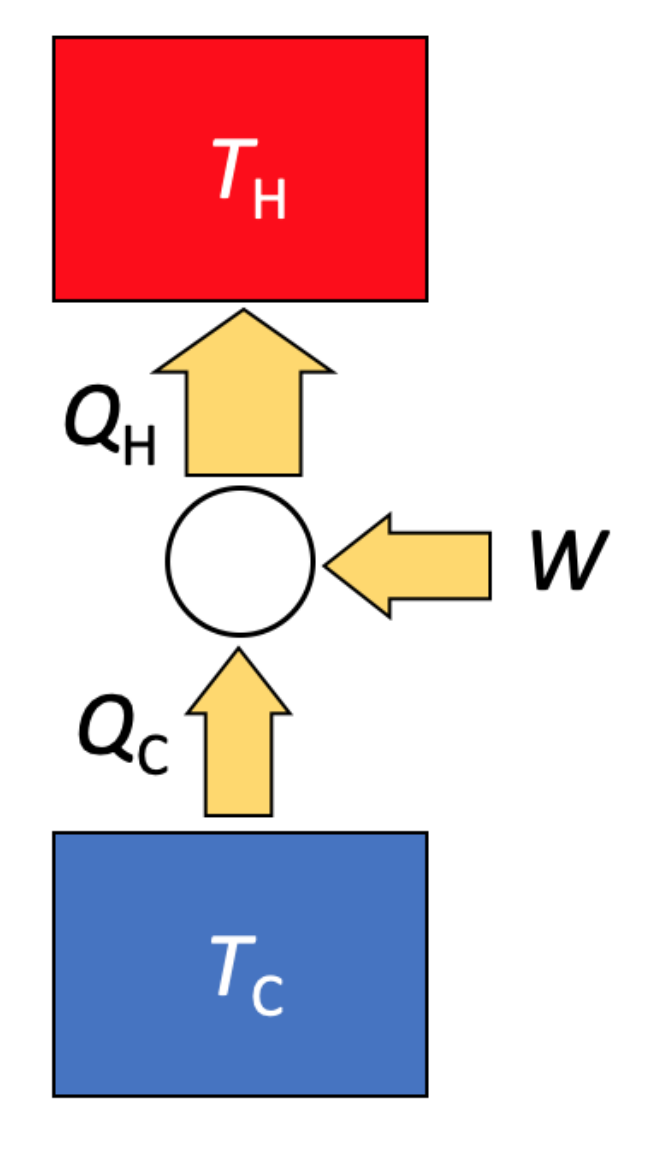
The diagram shows a machine (the white circle) that moves energy from a cold reservoir to a hot reservoir. We will consider whether a machine like this is useful for heating a family home in the winter when the temperature inside the family home is \(T_\text{H}\), and the temperature outside the house is \(T_\text{C}\). To quantify the performance of this machine, I'm interested in the ratio \(Q_\text{H}/W\), where \(Q_{\text{H}}\) is the heat energy entering the house, and \(W\) is the net energy input in the form of work. (\(W\) is the energy I need to buy from the electricity company to run an electric motor). Starting from the 1\(^{\text{st}}\) and 2\(^\text{nd}\) laws of thermodynamics, find the maximum possible value of \(Q_\text{H}/W\). This maximum value of \(Q_\text{H}/W\) will depend solely on the ratio of temperatures \(T_\text{H}\) and \(T_\text{C}\).
Sensemaking: Choose realistic values of \(T_\text{H}\) and \(T_\text{C}\) to describe a family home on a snowy day. Based on your temperature estimates, what is the maximum possible value of \(Q_\text{H}/W\)?
- Multiplicity of an ideal gas
S0 4191S
- (T3M.7) The multiplicity of an ideal monatomic gas with \(N\) atoms, internal energy \(U\), and volume \(V\) turns out to be roughly \begin{align} \Omega (U, V, N) = CV^NU^{\left(\frac{3 N}{2}\right)} \end{align} where \(C\) is a constant that depends on \(N\) alone. Use this expression, together with the fundamental definition of temperature, and they fundamental definition of entropy, to find \(U\) as a function of \(N\) and \(T\) for an ideal gas.
- (From the GRE PhysicsSubject GR0177, given in 2001)
Note 1: The irreversibility of this process tells you that entropy must go (up or down?).
Note 2: The gas constant, \(R\), is equal to Avagadro's number times \(k_B\).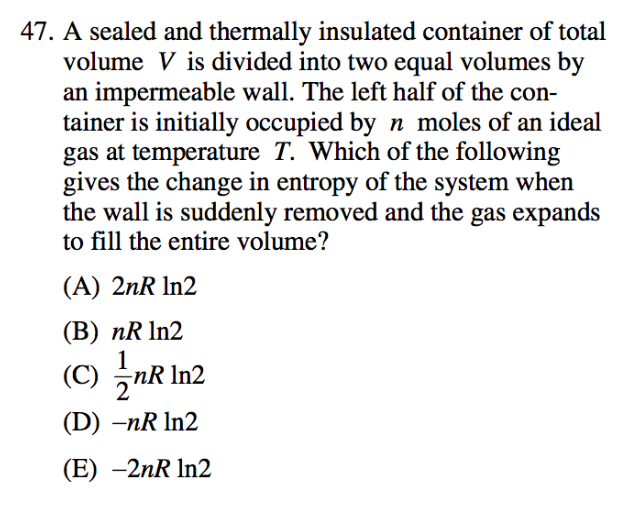
- Integration Techniques
S0 4191S
You should be familiar with three techniques for calculating integrals
- Equations and calculus
- Geometric shapes (calculating a generalized area)
- Simple numerical integration (a sum of \(y\)-values appropriately weighted by \(\Delta x\))
For the following three questions, pick the most appropriate integration technique. You'll be using a different technique for each question.
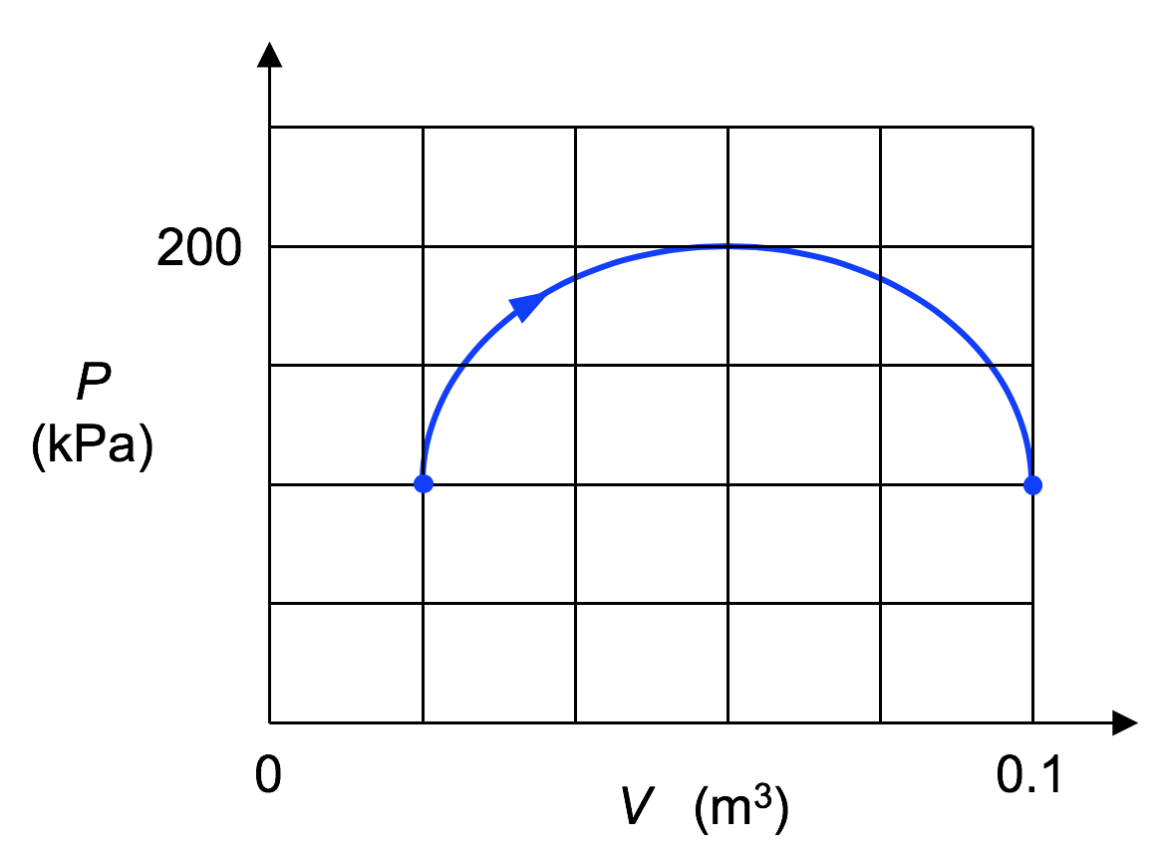
The blue curve on the PV diagram shows the pressure and volume of a gas over some period of time. The arrow indicates the direction from the initial state to the final state. Find the work energy going in (or out) of the gas to within \(\pm 5\%\). Use the standard sign convention to indicate which direction the energy is moving. Check the sign and units of your answer.
Consider compression of a gas for which the P-V trajectory follows the line \(P = (constant)\cdot V^{-5/3}\). The initial volume is 0.1 m\(^3\) and the final volume is final volume is 0.05 \(m^3\). The initial pressure is 100 kPa. Find the work done (use the standard sign convention). Check the sign and units of your answer.
- The following pressure and volume data were measured inside a cylinder of a 1.6-liter 4-cylinder engine. During an 8 ms time period, \(P\) and \(V\) were measured 8 times. The number of gas molecules inside the cylinder was fixed. Estimate the work done during the 8 ms time period (use the standard sign convention). Don't over-complicate this question, use a numerical integration technique that is reasonably accurate, but still simple to implement.
Time (ms) \(P\) (kPa) \(V\) (liters) 0 5000 0.05 1 3500 0.10 2 2500 0.15 3 1700 0.20 4 1100 0.25 5 600 0.30 6 400 0.35 7 300 0.40