Contemporary Challenges: Spring-2021
Homework 2 : Due 6 Friday
- Tea kettle
S0 4189S
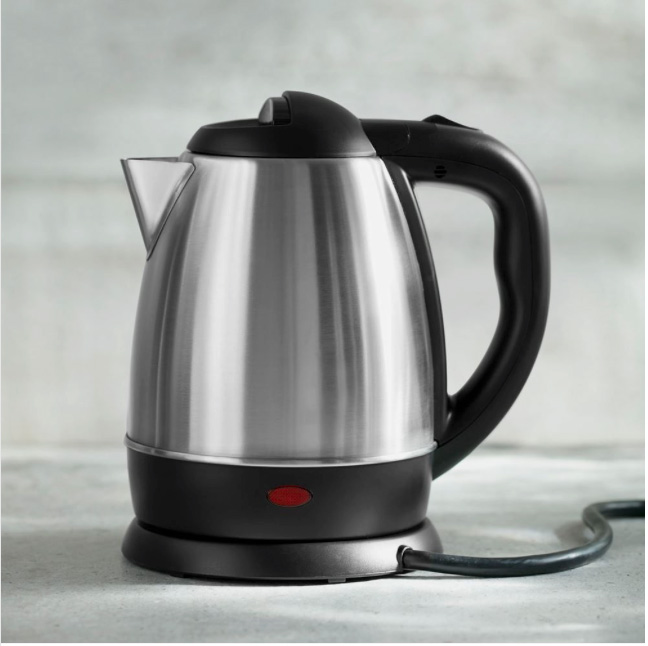
Consider the electric kettle shown in the picture. There is 1 kg of water in the kettle (4 cups of water). This electric kettle transfers energy to the water by heating. The rate of energy transfer is 1000 J/s. The specific heat capacity of water is 4.2 J/(g.K). Calculate the rate that the water temperature rises. Give your answer in units of kelvin/s.
Note: This is an exercise in proportional reasoning. You should not need to look up any formulas.
Sense-making: Put it in context---At this rate, how long would it take to heat up a kettle for making tea? Does this seem like a realistic number? - Wave energy
S0 4189S
The ocean swell lifts water against the force of gravity and makes water move in circular patterns. Energy can be harvested from this ocean swell: gravitational potential energy and kinetic energy are both available (see Chapter F of MacKay). Imagine I draw a line in the ocean that magically absorbs all of the energy associated with the swell, effectively flattening the waves.
If the line is parallel to the crest of the waves and has length \(L\), the time-averaged rate that energy must be absorbed to flatten the swell (energy per time) is \begin{align} \text{energy per time} &= \frac14 \rho g h^2vL \end{align} where \(\rho\) is the density of water, \(g\) is acceleration due to gravity, \(h\) is the height of the wave crest compared to flat water, \(v\) is the velocity of the wave crest. This equation is derived on page 307 of Sustainable Energy by David McKay.
A real device for harvesting wave energy can achieve an efficiency \begin{align} \text{efficiency} &= \frac{0.5\text{ J (electrical energy)}}{1\text{ J (wave energy)}} \end{align} Assume that typical Oregon deep-water waves have \(v = 15\) m/s and \(h = 1\) m. Estimate the electrical power that Oregon could capture if we built wave farms along the entire coast. Give your answer in J/s. There is 10-20% uncertainty in the estimates of \(v\) and \(h\), so the precision of your calculation and final answer should be consistent with respect to this uncertainty.
Sense-making: Make a Comparison---Divide your answer by the population of Oregon. How does the wave energy production rate compare to the rate that people are using energy (see the class notes from https://paradigms.oregonstate.edu/activity/730)?
- Heat loss from a single-family home in winter
S0 4189S
Consider a family home that has a floor area of 50 feet \(\times\) 50 feet, and a ceiling height of 10 feet. The house has typical the insulation for the Pacific Northwest: R-15 walls and an R-30 ceiling.
To help you with physics reasoning, I have converted the R-values into standard-international (SI) units for heat conductance per unit area: \begin{align} \text{wall conductance per unit area} &= 0.4\text{ }\frac{\text{W}}{\text{K}\text{.m}^2}\\ \text{ceiling conductance per unit area} &= 0.2\text{ }\frac{\text{W}}{\text{K}\text{.m}^2} \end{align} Based on the units listed above, and the context (thermal insulation), you can visualize the meaning of these proportionality constants. For example, if there is a 1 kelvin temperature difference between inside/outside the house, every square meter of wall will leak energy at a rate of 0.4 J/s. Doubling the temperature difference, or doubling the wall area, will double the leak rate.
If the indoor temperature is 293 K (68\(^\circ\)F), and the outdoor temperature is 273 K (32\(^\circ\)F), how fast does heat energy leak out of the house (joules/second)? For this question, please assume the floor is perfectly insulated so that no heat leaks out of the floor.
Sense making 1: Three of the most significant categories of human energy use in the United States are (1) the embodied energy of the stuff we buy \(\approx\) 170 MJ/day per person, (2) the energy used driving cars \(\approx\) 140 MJ/day per person, (3) the energy used by jet flights \(\approx\) 100 MJ/day per person (all these energy rates are averaged over the course of a year). How does the heat loss from a family home compare to the other categories on this list?Sense making 2: How many small, portable heaters are needed to heat this house? (assume 1 kW heaters). Does this seem like a realistic number of heaters?
- Speed of a solar car
S0 4189S
This self-driving solar car is travelling on a flat road on a windless day. The sun is directly overhead.
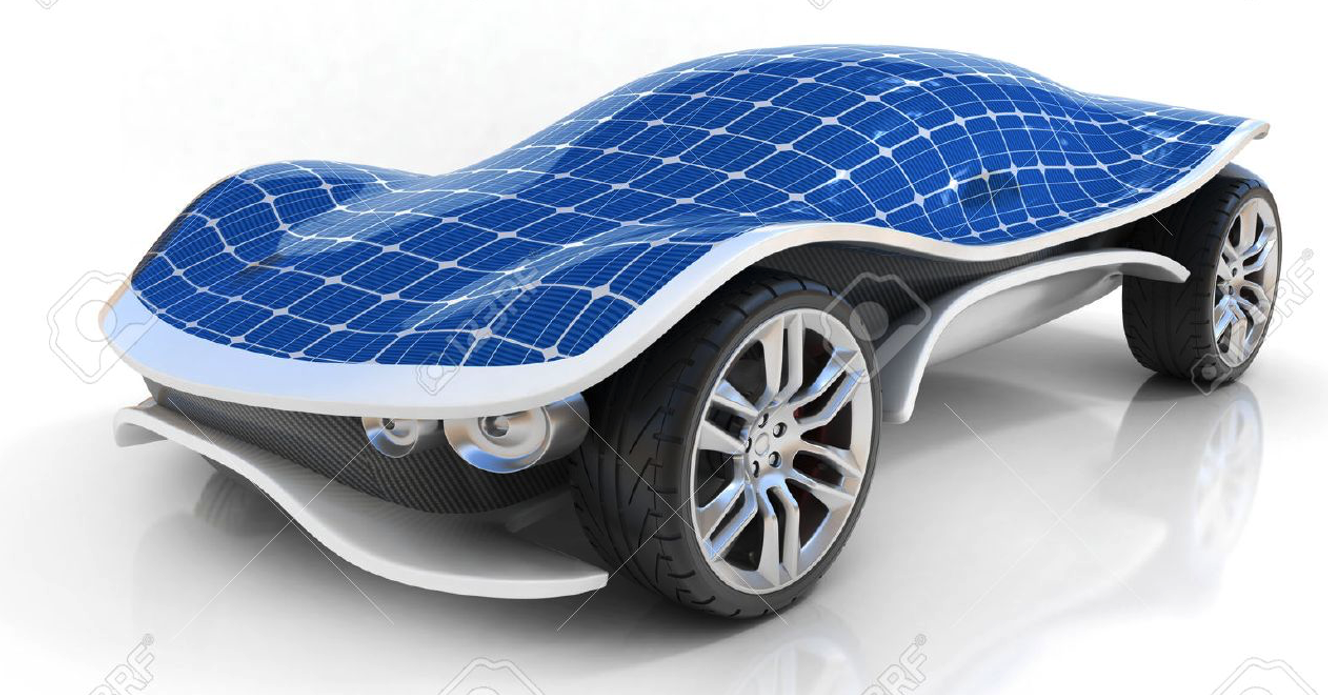
(a) Draw an energy flow diagram to describe the system. An arrow at the top of the flow diagram will represent incoming solar energy (landing on the solar panel). One circle will represent the solar panel, and one circle will represent the electric motor. Label each arrow with the correponding value of energy flow (a quantity measured in joules per second).
(b) Estimate how fast this self-driving solar car can travel on a flat road on a windless day when the sun is directly overhead. Give your answer in meters per second.
Use the following parameters for the system:
- The car is 1.8 m wide, 1 m tall and 3 m long. The top surface of the car is entirely covered with solar panels.
- The sun is directly overhead and the intensity of the sunlight is 1000 J/(s.m\(^2\)).
- The electric motors are powered directly by the solar panels (no battery power).
- The solar panels convert sunlight energy into electrical energy with 20% efficiency (the other 80% of sunlight energy is heating the solar panel).
- The electric motors convert electrical energy into mechanical work with efficiency 90% efficiency.
- The drag coefficient is 0.2.
- The energy dissipation associated with the tires rolling on the road can be neglicted.