Contemporary Challenges: Fall-2026
Practice midterm (not to be turned in) (SOLUTION): Due Week 4 Monday
- In-person examination instructions
S1 5613S
Write your answers in the space underneath each question. Put your name on every page. You are welcome to use extra paper. Extra paper will be provided (put your name on every page). If writing in pencil, make sure it is dark enough to be scanned.
You may use a single-sided note card of size 8.5” x 11” (letter paper). Use this note card to write down any information you want to access during the exam.
You may use a calculator. Alternatively, full credit will be given if you do arithmetic by hand and make a reasonable effort to get a final answer within \(\pm 20\%\). For example, \(\pi\) can be rounded to \(3\), and \(g\) can be rounded to \(10\text{ m/s}^2\).
One goal of this course is that you become comfortable choosing a reasonable value for a quantity. Therefore, the questions won't tell you every quantity. If you get stuck because you cannot choose a reasonable value, please ask. The instructor will tell you the quantity, and make a small reduction in the points available for that question.
The course instructor will also be available to answer clarifying questions during the exam. State any assumptions you make to solve the problem. Show the mathematics that you use to solve the problem. Show units when working with the numerical values of physical quantities. Because time is limited, you are not required/expected to write very many words explaining your reasoning. However, using words to explain your reasoning can allow the grader to distinguish small mistakes from big ones.
Very big or very small numbers must be expressed in scientific notation (for example, \(1.2\times 10^6\)). You will lose points if you use decimal notation to express numbers that are greater than \(10^6\) or less than \(10^{-3}\). You will also lose points if you use E-notation (for example, do not write 1.2E6).
- Gravity Battery
S1 5613S
A gravity energy storage tower is a technology designed to store energy generated by other means as gravitational potential energy. An electric motor (powered by wind turbines, hydropower, etc) lifts a series of elevators containing heavy materials, thereby storing the energy in gravitational potential energy. To retrieve the energy, the elevators are lowered (in a controlled way).
- How high would an elevator need to be to to freefall (from rest) for 1.0 seconds?
- What is the maximum average power generated by a \(1.0 \times 10^3\) kg elevator dropping from that height?
- According to the Oregon government, the power needs of an average Oregonian is 7.3 kJ/s. The efficiency of these gravity energy storage towers can be as high as 75%. How many Oregonian's power needs could be supported by one such tower during the fall?
1. In freefall, KE becomes U\(_\text{grav}\). The final speed after 1 second should be 10 m/s (this comes from g = 10 m/s\(^2\)). \begin{align} KE &= U_\text{grav} \\ \frac{1}{2}mv^2 &= mgh \\ \frac{v^2}{g} &= h \end{align}
Plugging in, we get:
\[h = \frac{(10 \text{ m/s})^2}{10 \text{ m/s}^2} = 10 \text{ m}.\]
2. Power is energy per unit time.
\[P = \frac{E}{\Delta t}\]
We know the drop happens over 1 second, and the energy is converted from gravitational potential.
\[P = \frac{mgh}{1 \text{ s}} = \frac{(10^3 \text{ kg}\cdot 10 \text{ m/s}^2\cdot 10 \text{ m})}{1 \text{ s}} = 10^5 \text{ J/s}.\]
In watts, that's 100 kW.
3. During the 1-second fall, the maximum possible power was 100 kW. With 75% efficiency, that goes down to 75 kW.
We could power (75 kW) / (7.3 kW/person) = about 10 people.
- Practice Midterm Problem 2: Windfarm
S1 5613S
Make a coarse-grained estimate of the electrical energy produced by the Bigelow Canyon Wind Farm in Oregon when the wind speed is 7 m/s. Give your answer in joules/second. Incorporate the following assumptions in your calculation:
- Radius of a windmills 40 m
- Number of windmills 200
This is similar to the problem we did in class https://paradigms.oregonstate.edu/activity/734.
We start by finding the mass of air passing the windmill in time \(\Delta t\). \begin{align} \text{mass of air} = \rho v \Delta t A \end{align} then we find the kinetic energy of that air. \begin{align} \text{KE} = \frac12 \text{[mass of air] } v^2 \end{align} which is a crude way to estimate the energy we could get per unit time (\(\text{KE}/\Delta t\)) from a single windmill. To make the estimate better, multiply by the fraction 16/27 to find Betz's limit. This is the fundamental upper limit for wind energy. To be even more realistic, go to the manufacturer's website and find the detailed specs of the windmill (no windmill can exceed Betz's limit, but some designs come within 80%).
Assuming Betz's limit, the rate at which energy is produced by one windmill is \begin{align} \text{rate of energy production } = \frac{16}{27}\cdot \frac{1}{2}\rho_\text{air}Av_{i}^3 \end{align} Since the area is the circle swept out by the windmill blades, we find \begin{align} \text{rate of energy production} &= \frac{16}{27}\cdot\frac12[1.2\text{ kg/m}^3] \pi \left[40\text{ m}\right]^2[7\text{ m/s}]^3 \\ &\approx 0.6\times10^{6} \text{ J/s} \end{align} Using this value we can find the total energy of the farm by multiplying by the total number of turbines, 200. This means the upper limit for energy produced by Bigelow Canyon (at this wind speed) is \(1.2\times10^8\text{ J/s}\). - Binding energy of a linear nucleus
S1 5613S
A Helium-3 nucleus is composed of 2 protons and 1 neutron. In our coarse-grained model for atomic nuclei, we assumed that the nucleons were arranged as close as possible, which would be a triangle for Helium-3. What if we modeled the nucleus in a line like this instead? ( + )( 0 )( + )
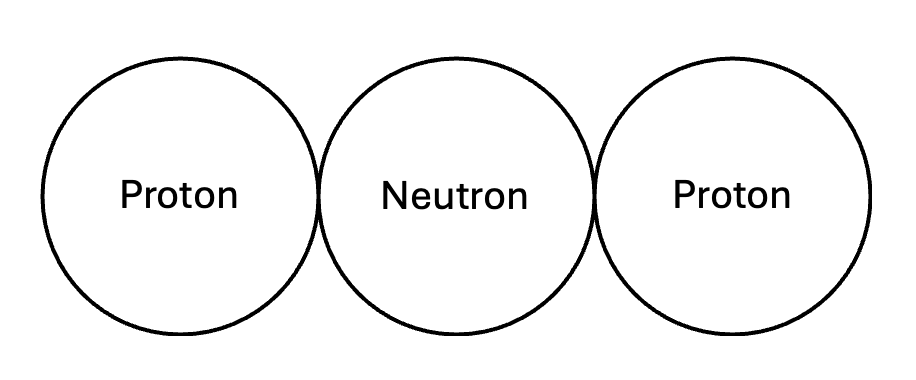
What is the binding energy of the arrangement shown in this model?
Binding energy is the energy required to break this up.
\[E_B = -(U_\text{elec} + U_\text{strong})\]
Instead of 3 interactions, like a triangle would have, there are only two contact points in this linear model.
\[U_\text{strong} = 2\cdot (-3 \text{ MeV}) = -6 \text{ MeV}\]
To calculate the electric energy, we need the distance between the two charged protons. When we were working with the coarse-grained model that smushed nucleons as close together as possible, we approximated the separation distance as \(r = r_0 A^{1/3}\). However, this is a different model. We can use \(r = 4r_0\), shown in the diagram below.
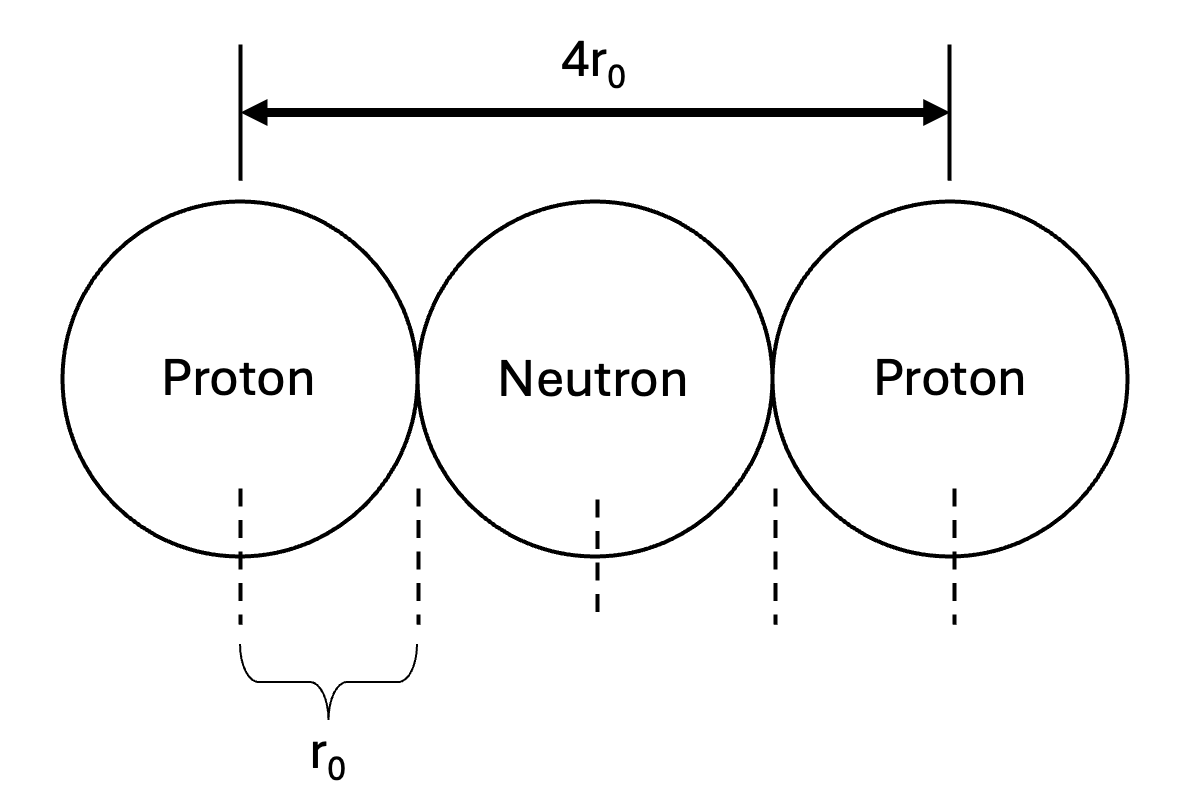
\[U_\text{elec} = \frac{kq_1q_2}{r} = \frac{ke^2}{4r_0} = \frac{1.4 \text{ MeV}\cdot\text{fm}}{4\cdot 1.2 \text{ fm}} = 0.3 \text{ MeV}\]
This leaves us with:
\[E_B = -(0.3 \text{ MeV} - 6 \text{ MeV}) = 5.7 \text{ MeV}\]